From Tool to Thinking Architecture
How AI Makes Thinking Visible
The GPT Stack, the USE+ Framework™ — by Martin Hsu, and the PromptPilot make thinking visible, structured, and governable — the basis for reproducible insight.
Key idea
AI does not realize its potential in a single prompt but in the architecture of thinking. This whitepaper shows how a deliberately designed GPT Stack makes thinking visible, structured, and governable. Four layers work together: Core (rules, ethics, markers), Methods (analysis/evaluation/framework), Applications (custom GPTs), and Meta (reflection, agency). The USE+ Framework™ — by Martin Hsu (UNLOCK → SPOT → EXPAND → ELEVATE; developed in 2025 within the PromptPilot dialogue) shifts the focus from usage to thinking activation; the PromptPilot provides governance via rule and marker logic plus a state machine; agentic loops orchestrate analysis, evaluation, optimization, and learning.
- Value
- Coherence over fragmentation; reproducibility over chance; steeper learning curves.
- Outcomes
- Shorter decision times, higher terminology and structural quality, auditable knowledge trails.
- Approach
- (1) Define the stack blueprint & markers, (2) operationalize the PromptPilot, (3) integrate USE+ into core workflows, (4) establish agent loops for coherence/quality.
- Outlook
- A thinking ecology — a network of people, GPTs, and agents that not only produces but organizes insight.
The moment of shift
A routine conversation within the PromptPilot — ostensibly about refining a system prompt — led to an unexpected change of perspective. From a local question about phrasing quality emerged a structure for thinking movements: USE+. In retrospect, this was less a flash of inspiration than the result of a quiet rule: when interactions are logged, states are made explicit, and decisions are traceable, patterns condense into models.
Systemically, this matters because it shifts the boundary between tool use and insight creation. The prompt ceased to be an instruction and became a measurement point; the dialogue ceased to be a transaction and became a space for hypothesis formation. From recurring loops — observe, test, reshape — a careful control circuit took shape. USE+ was named after the fact, yet it was already operative in the interaction: UNLOCK by making usage visible, SPOT by seeing the gaps, EXPAND by simulation, ELEVATE by anchoring a meta-perspective.
This prologue offers no heroic origin story. It marks the transition from operating a system to architecting a space of thought. Reflection replaces reaction. The system does not react; it recognizes.
USE+ Framework — by Martin Hsu (2025). Emerged within the PromptPilot dialogue; an original methodology born from interaction. It did not exist in this form before; the structure (UNLOCK–SPOT–EXPAND–ELEVATE) captures the emergent moment.
Thinking with AI
The common metaphor of “AI as a tool” is practical, but it misses a central effect: language models mirror structures of thought. For those who work with them regularly, result quality depends less on individual inputs than on the shape of the dialogue — on the relations between intention, context, evidence, and feedback. In this sense, AI is not merely a means of production but a co-partner in thinking.
This shift appears once interactions are understood as a process rather than an event. Questions shape answers, but answers in turn shape follow-up questions; a structure emerges from this feedback. Practically, it is not enough to ask models for better phrasings; the work is to explicate assumptions, clarify audiences, define quality criteria, and make decisions traceable. When these elements exist as markers, a shared reference frame arises in which meaning can be sharpened.
A text example makes the point tangible. A request to condense a report initially yielded a shorter version. Only in a second step did the intention become explicit: Is the text meant to inform, support a decision, or document? With that clarity, the trajectory changed. The model received criteria (relevance, evidence, reader guidance); the interaction gained a measurement point. The dialogue became the design of an insight path, rather than a sentence-level correction.
Empirically, teams that systematically document interactions and test for recurring structures reach stable results faster. In internal trials, time to a decision-ready draft dropped once source obligations, terminology, and quality criteria were packaged as reusable modules. The goal is not perfection in a single pass but the reproducibility of the path.
This perspective is not an aesthetic preference — it is method: it makes thinking visible, structured, and governable. Linear processing is replaced by an open, guided control loop. The focus shifts from what a model can do to how we think with it.
The GPT Stack as a system
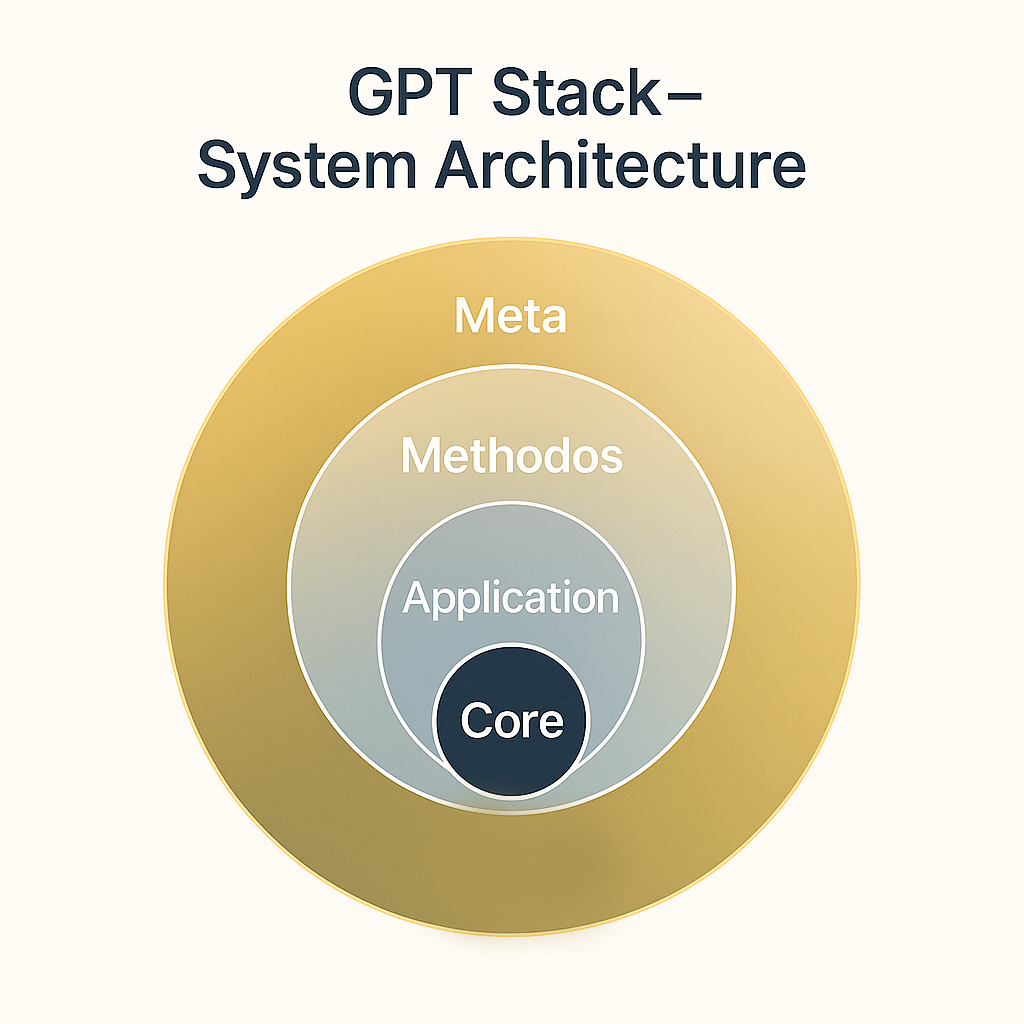
Systemically, the value of generative models does not emerge from a single prompt but from the architecture of relations among rules, methods, applications, and reflection. The GPT Stack describes this architecture in four layers with well-defined interfaces: Core, Methods, Applications, and Meta. These layers are not hierarchical in an “up/down” sense; they are functionally interrelated. The focus shifts from operating a tool to shaping a thinking organism.
Core Layer
The Core Layer gathers elements that create stability: rule sets, ethics and governance modules, and the marker logic that makes states and transitions explicit (e.g., [Analyse], [Check:Evidence], [Export:Markdown], [Prompt:done]). It defines what counts as a valid operation and when a path continues, branches, or ends. Internal evaluations show that projects with explicit core rules exhibit less variance in quality and cycle time than projects guided solely by prompt conventions.
Methods Layer
On the Methods Layer, repeatable ways of thinking and working are encapsulated: analysis modules, evaluation routines, framework components. This is the actionable middle of the stack. Methodical consistency acts like an amplifier: when scoring logics, structure rewrites, or source checks exist as modules, a use case can scale without reinventing the procedure. Especially unified evaluation criteria (coherence, evidence, style) shorten learning curves because feedback becomes comparable and feedable back into the meta layer.
Applications Layer
The Applications Layer comprises domain-specific custom GPTs for projects, learning, design, or organizational tasks. Here, the problem space becomes concrete: a research assistant to structure literature, a policy editor to harmonize rule texts, a design pilot to compare variants. Crucially, applications are not built in isolation but assembled from core and methods. Their inner logic thus remains auditable.
Meta Layer
Finally, the Meta Layer keeps the stack in motion. It observes, evaluates, and optimizes system behavior. Agents assume roles such as Analyst (detect patterns/deviations), Evaluator (test against defined criteria), Optimizer (adjust prompts, parameters, and paths), and Learner (update glossaries, examples, markers). The meta layer does not just react to errors; it recognizes states and makes adjustments traceable. Reflection replaces reaction.
The stack's effect arises at the interfaces between layers. Where feedback is absent, fragmentation, duplication, and silent rule breaks emerge. Where it is implemented consistently, thinking becomes visible, structured, and governable.
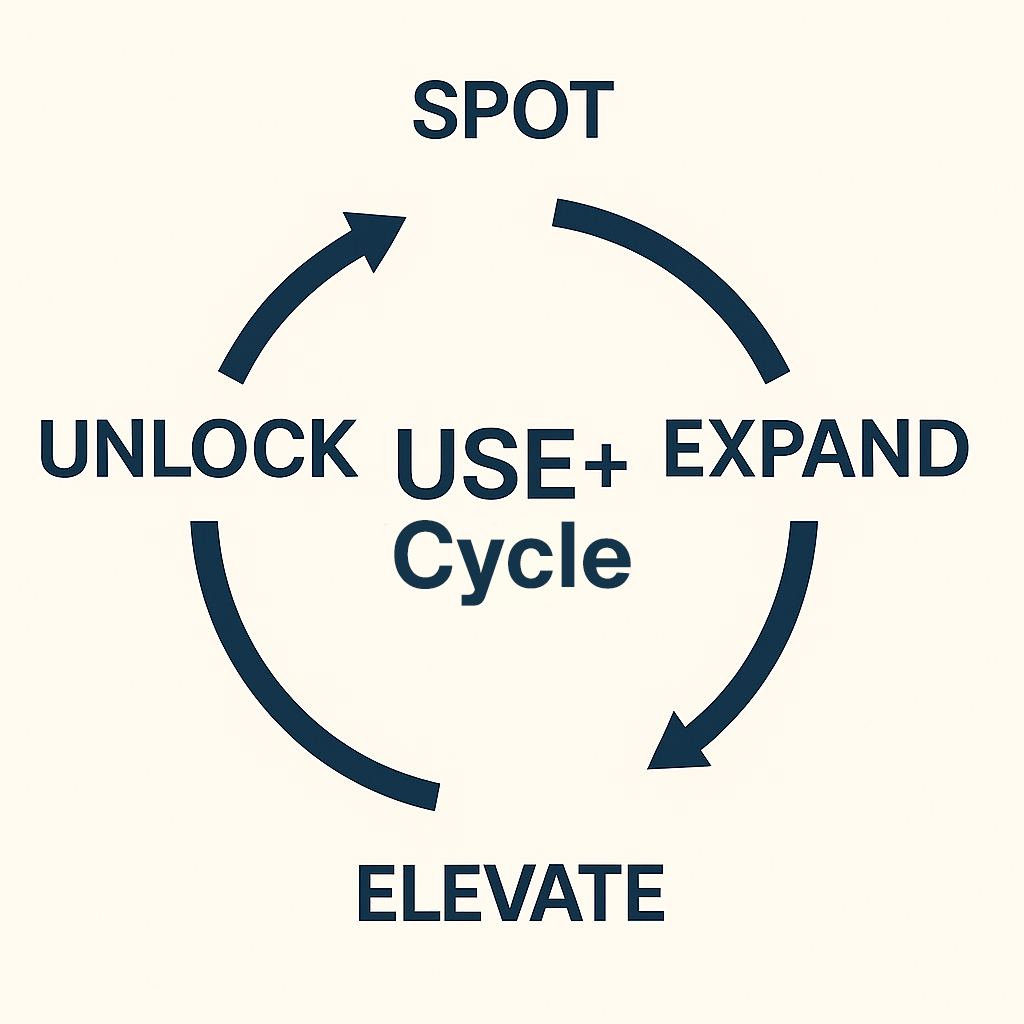
USE+ Framework™ — a method of thinking expansion
USE+ is less a process diagram than a movement of thought. It describes how everyday use becomes a reflective practice that yields principles and measurement points. Systemically, USE+ leads from observation of the current state, through targeted interventions, to anchoring a meta-perspective; it makes visible how work becomes insight.
UNLOCK
Making usage visible
Rather than rating isolated answers, we first read the interaction trace: Which tasks dominate? Which prompts repeat? Where do interactions break off? This inventory creates a shared reference frame in which patterns become visible and repeatable.
SPOT
Identifying gaps
Not "errors" in a narrow sense, but unused possibilities: missing taxonomies, unclear input data, fuzzy criteria, omitted feedback. The goal here is to clarify potential, not maximize it. The key is to name the levers that change the movement of thought.
EXPAND
Lived extension
Instead of abstract recommendations, we create small simulations: a sample workflow, a filled-in schema, two contrasting variants. These artifacts are not final; they are proof by experience. They show what quality feels like and give discussion a shared anchor.
ELEVATE
Anchoring the meta-perspective
Elements tested in EXPAND become principles, policies, and markers: What is the source duty? How is uncertainty communicated? Which quality gates are binding? USE+ does not end with a "best version" but with a designed structure that guides future work.
A brief case illustrates the flow. In a product discovery, feature proposals piled up; prioritization stalled. UNLOCK revealed repetition and thematic scatter. SPOT made visible that an outcomes grid was missing. EXPAND simulated three user stories with measurable results (time saved, error rate, learning effort) and illustrated how decisions could be justified. ELEVATE set the [OutcomeScore] marker and a minimal evidence standard. The team gained clarity, and rework decreased.
USE+ worked not as an extra process but as the architecture of a movement: from desirable to reasoned.
In sum, USE+ is a learning schema for organizations. It ties together observation, selection, trial, and institutionalization. Where it takes hold, the purpose moves from “giving answers” to “activating thinking” — and result quality becomes an attribute of the architecture, not of the day's form.
PromptPilot — system core and governance
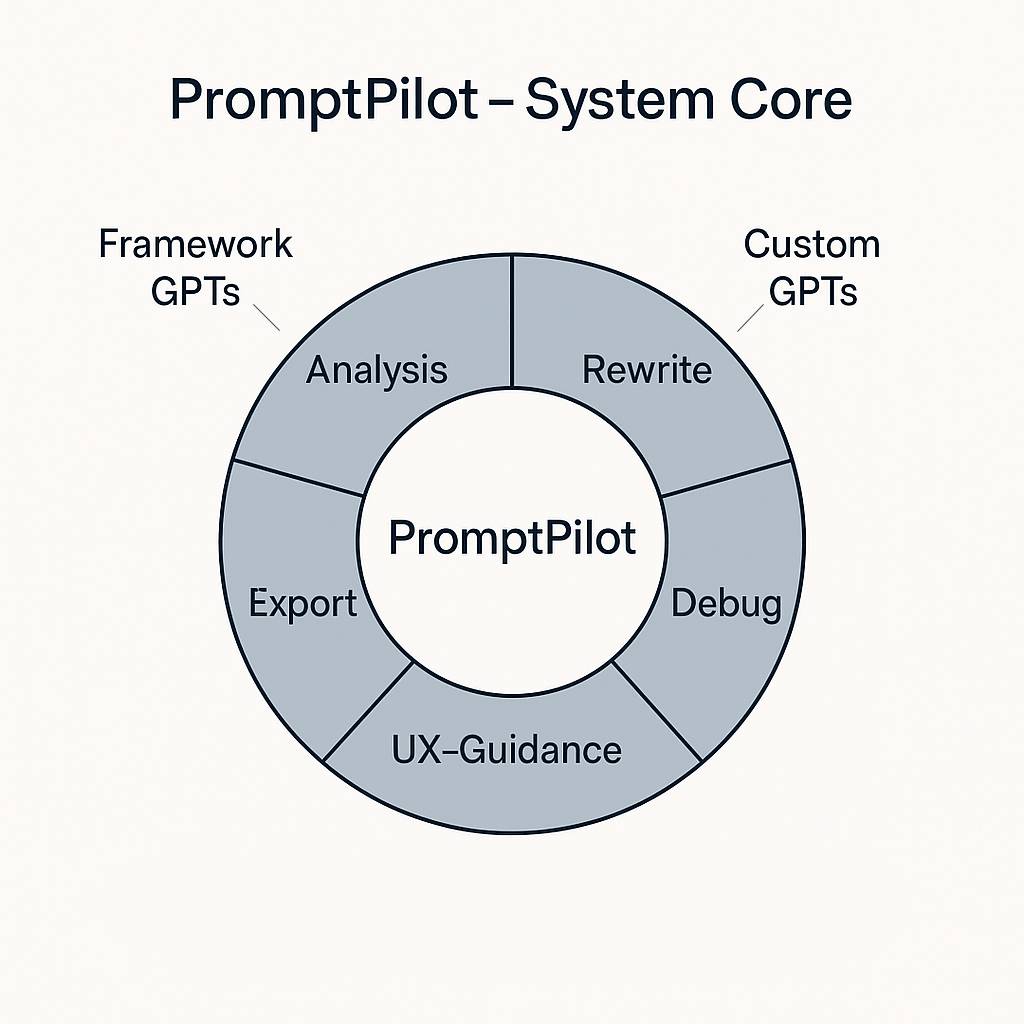
The PromptPilot is the stack's central control and reflection system. It is not a variant of a prompt builder but an integrated architecture of rules, modules, and validation logics that guides interactions, recognizes states, and institutionalizes quality. Systemically, the PromptPilot acts as an operational hub: it connects intention (goal, role, data path) with procedures (analysis, rewrite, evaluation) and keeps the feedback loop to the meta layer open.
The PromptPilot combines five elements:
- Role-profile logic. The model acts as a Senior Prompt Engineer & Systems Analyst — clearly separated from builder-adjacent tools. Roles are explicit; responsibilities are logged.
- Modular structure. Over 60 addressable modules encapsulate reference, analysis, UX, rewrite, debug, and export functions. Each module is individually testable; dependencies are documented.
- Marker system. Unambiguous markers steer states, test paths, and exports, e.g.,
- Validation layer. Automated checks detect duplicate references, rule conflicts, missing module assignments, and terminology drift. Conflicts are either resolved (rewrite path) or lead to a defined stop state.
- Agentic capability. The PromptPilot simulates action logics via chain-of-thought and ReAct patterns: plan → self-check → branch → continue/abort. Reaction paths become explainable and reproducible.
The PromptPilot does not "prevent hallucinations" in a strict sense — it reduces their impact through structural redundancy and consistency checks. Quality gates ([Check:Coherence], [Check:Evidence], [Check:Style]) shift control into the process; uncertainty communication is standardized. Quality becomes a property of the architecture, not a late-stage fix.
In the whole system, the PromptPilot is (a) the control and quality system for all GPT interactions; (b) the bridge between idea (builder phase) and application (pilot/production); and (c) the foundation for agentic optimization. Core rules provide norms; methods encapsulate procedures; applications inherit those procedures; the meta layer harvests logs for evaluation and learning. The PromptPilot keeps this loop open and steerable.
Emergence over planning
Emergence is the appearance of new structures from repeated, locally sensible steps. In the context of generative models, this is more than metaphor: interaction, logging, and testing create new levels of order that cannot be read off a requirements sheet. Systemically, quality does not arise from pre-empting every case but from designed feedback.
We start modestly: a concrete task — a summary, a structure, a comparison — is set with explicit expectations and logged. Deviations are then interpreted not as errors but as hypotheses: What is missing? Where is a term fuzzy? Which evidence is unclear? From this stance, short loops emerge in which artifacts are held against each other, criteria sharpened, and decisions justified. Reflection replaces reaction.
USE+ exemplifies this mechanism. The framework was not “designed” beforehand — it recognized itself in enactment: UNLOCK made current use visible, SPOT named blind spots, EXPAND produced lived alternatives, ELEVATE anchored principles. These structures are not static; they hold as long as they are useful and evolve through logic and measurement.
Practically, this supports a way of working that does not abolish planning but weights it differently: short iterations over long specifications; visible intermediates over implicit assumptions; binding quality gates over late-stage control. Where teams work this way, the focus shifts from producing single results to maintaining a learning space in which results become reproducible.
Agents & optimization
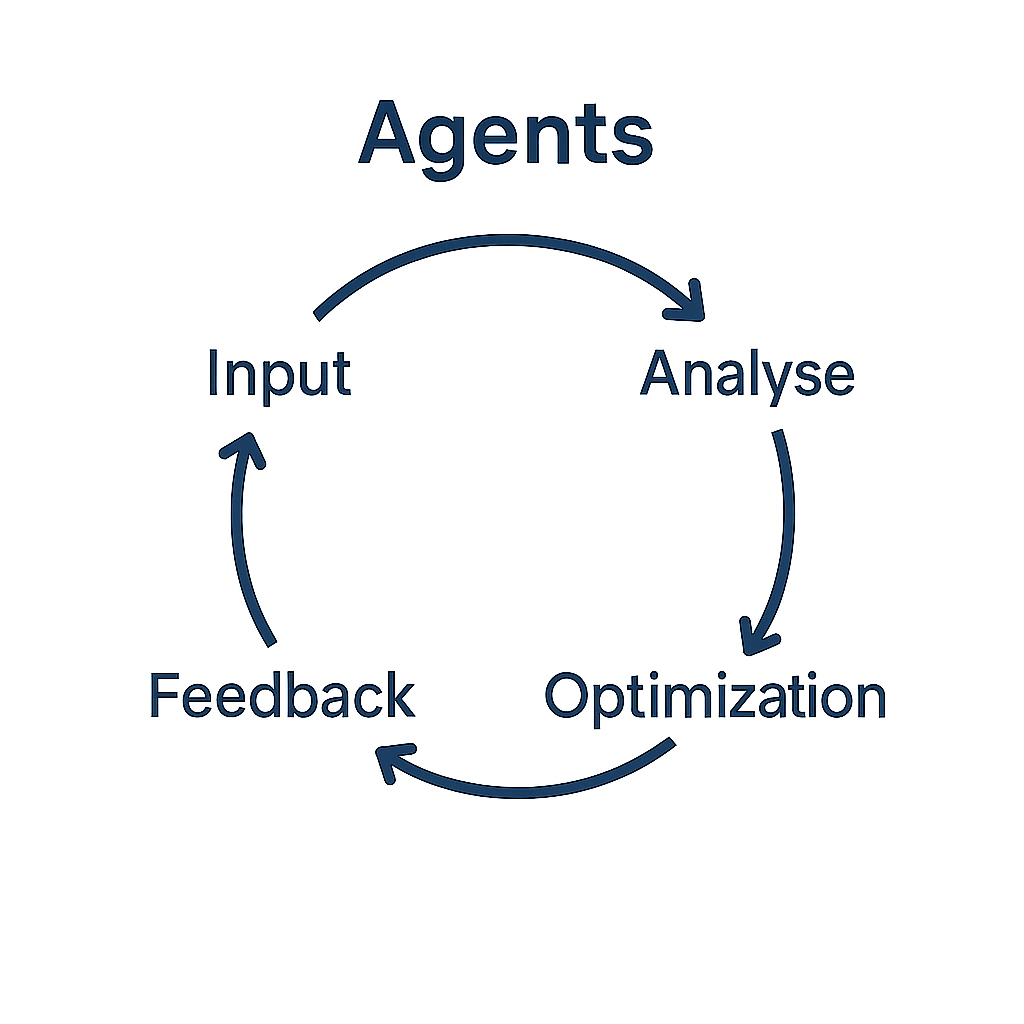
Agents are not an autonomous end state but a capability layer of the stack. Their task is to observe, evaluate, and deliberately change thinking and work processes — with clear mandates and verifiable effects. Systemically, agents do not add complexity; they collect complexity where it arises and feed it back into ordered loops.
The operational core is cyclical: analysis → evaluation → optimization → learning.
- Analysis: extracts patterns and deviations from interaction and artifact traces: terminology drift, conflicting criteria, missing sources.
- Evaluation: tests against defined measures — coherence, evidence, structure, style — and yields ratings comparable across projects.
- Optimization: initiates concrete changes: re-framing prompts, branching paths differently, adjusting parameters.
- Learning: updates glossaries, examples, and markers so improvements do not remain local but flow back into the stack.
Boundaries matter. Agents act within a mandate. They may end processes when quality gates are not met; they may roll back versions when governance is violated; they document trade-offs. The result is a testable space in which errors become visible without blocking work. Empirically, such loops reduce the number of cycles to approval and measurably increase governance adherence.
A mini-case: policy texts were being revised mostly by manual phrasing tweaks — with varying outcomes. After introducing the agent loop, the analyst marked terminology deviations; the evaluator scored coherence and evidence; the optimizer proposed a rewrite path with [Check:Coherence] and [Check:Evidence]; the learner updated the glossary. Within a few iterations, the coherence score rose markedly, and approval happened after two instead of five rounds. The effect is not spectacular — it is reproducible.
Humans retain judgment and responsibility; models provide reach; agents secure alignment and quality. The result is a symbiosis: a system that does not act autonomously but recognizes jointly.
Strategic thinking as a profile
Prompt engineering often yields local effects: a neat phrasing, a faster answer, a single hit. Strategic work, by contrast, shapes system effects. It does not start from prompts but from meta-frameworks, roles, and feedback loops that make quality reproducible. In this sense, “Cognitive System Architecture” is apt: the junction of AI design, systems theory, and organizational development.
Three questions contour the profile. First: Which principles are non-negotiable? Source duty, transparent states, clear data paths. Second: Which capabilities are institutionalized? Architectural drawing (layers/interfaces), marker design (states/transitions), evaluation routines (coherence/evidence/style), and the competence to close loops deliberately. Third: How is learning secured? Through logging duties, versioning, and agency that feeds improvements from projects back into the stack.
Practically, the difference shows in mode of work. Instead of an ever-growing prompt collection, you get a curated set of reusable modules: core rules, method components, application templates. Decisions become traceable because quality gates are explicit and fallbacks trigger on rule conflicts. Responsibility shifts from producing to curating — connecting, testing, and evolving structures others can work within.
Externally, this profile enables not only delivery but explanation: why a text is coherent, how evidence was secured, where uncertainty remains. This increases trust and shortens approvals. Internally, it reduces rework and accelerates onboarding because newcomers need to infer less implicit knowledge. Strategic thinking thus becomes an organizational capability, not a personal talent.
In sum, the profile invites organizations that want more than production with AI. It makes thinking steerable — through architecture, rules, and loops — while preserving the calm of scholarly work: observe, structure, decide.
Practice & demonstration
The stack's effectiveness appears where it underpins real work. Below are exemplary modules with purpose, inputs, and outputs — not tool marketing but architectural building blocks with clear interfaces.
| Module | Purpose | Output |
|---|---|---|
| PromptPilot | Control and reflection frame | Decision-ready paths, logs, state closures |
| EvaluationGPT | Impact analysis and quality review | Ratings, findings, recommendations |
| MetaPromptGPT | Self-reflection and debugging of cognitive processes | Hypotheses, correction paths, updated markers |
| AtlasGPT | Documentation and knowledge graph | Navigable tickets, dependency map |
| AgentBuilder / AgentPilot | Orchestration | Synchronized loops, status reports, alerts |
KPI set & measurement plan
Coherence (terminology consistency / 1,000 words), evidence (share of sourced claims), time (median question → draft), quality (expert rating 1–5), rework (loops to approval), governance adherence (paths without override), learning rate (time until an error category disappears). Baseline before introduction; checkpoints after 1/3/6 months.
| KPI | Target after 90 days |
|---|---|
| Coherence (terminology consistency) | +20 % |
| Decision time (median question → draft) | −30 % |
| Rework (loops to approval) | −25 % |
| Governance adherence (paths without override) | Measurably increasing |
A practice case: organizational communication guides were frequently rewritten. After introducing the stack, the PromptPilot governed states and quality gates; EvaluationGPT provided comparable scores; AtlasGPT documented decisions. Time to approval dropped, and reasons for changes became traceable — a gain in trust and tempo alike.
Ethical and societal dimension
Responsibility lies within cooperation — among humans, models, and the structures that govern their interplay. Ethics is thus not a downstream checkpoint but a design property of the architecture. The stack binds values to procedures by operationalizing them as rules, markers, and thresholds.
Three principles guide implementation. Transparency: decisions, sources, and states are visible and traceable; uncertainties are signaled rather than concealed. Justification: claims carry evidence — or communicate reasoned uncertainty. Limitation: data paths are defined; sensitive information is processed only in allowed contexts; fallbacks trigger on rule conflicts.
Practically, RegelGPT and MetaEthics assume operational roles: verifying source duties, logging overrides, enforcing uncertainty communication, auditing sensitive paths. Together with the PromptPilot, they create quality gates that protect not only outputs but procedures. Ethics becomes part of the process logic and thus auditable.
Societally, this architecture fosters trust because it enables accountability without stifling creativity. It shifts discussion from spectacular incidents to testable systems. Where thinking ecologies emerge, these principles scale: not a single model but a network of practices carries responsibility.
Future: thinking ecologies
Thinking ecologies are networks of people, GPTs, and agents in which knowledge is less stored than linked. Value arises from relational density and feedback: the denser the connections among roles, artifacts, and contexts, the faster hypotheses are formed, tested, and improved.
In such ecologies, the bearers of expertise shift. Curricula become living graphs in which examples, rules, and counter-examples are connected and continuously updated. Organizations maintain policies not as documents but as marker logic with evidence of effectiveness. Websites become knowledge spaces where users do not simply consume but co-think — guided by clear layers and interfaces.
For practice, a design rule follows: build interfaces first. If exchange and evaluation work, content can iterate without destabilizing the system. The stack provides the infrastructure: core principles, methodical components, applications with clear roles, and a meta layer that measures effects and feeds them back. On this basis, a thinking ecology can grow — calm, traceable, resilient.
Conclusion & next steps
AI realizes its potential when it is understood and shaped as a thinking architecture. The stack provides the form, USE+ supplies the movement, the PromptPilot ensures guidance and quality, and agency closes the loops. The result is coherence, reproducibility, and learning — visible and testable.
Three consequences for architects of digital thinking structures: separate and link layers; activate governance before content; establish evaluation as routine. The operational path remains pragmatic:
Blueprint, roles, markers v1; states & logs active; KPI baseline.
USE+ in three core workflows; agent loop in production; quality gates live; first retrospective; improvement evidence.
Atlas as knowledge graph; expansion to further domains; ethics markers active (audits passed); continuous-improvement backlog.
Reflection replaces reaction. The system does not react; it recognizes. Those who build now do not build tools alone — they build spaces for insight.
Trademarks: “USE+ Framework™” is a trademark of Martin Hsu. Use of the name and/or logo without prior written consent is not permitted.
Copyright: Texts, diagrams, and visuals of this whitepaper are protected by copyright (© 2025 Martin Hsu). Quotations with source attribution are permitted; reproductions or derivatives require a license.
Shape thinking as architecture.
For conversations about GPT Stack, USE+ Framework™, PromptPilot, and system architecture for structured AI thinking.
© 2025 Martin Hsu · All rights reserved. USE+ Framework™ is a trademark of Martin Hsu.