AI as a Cultural Accelerator
Societal Conditions for Expanding Human Knowledge, Collaboration, and Development

The societal significance of AI is decided not by its performance alone, but by the conditions under which individual assistance can give rise to verifiable knowledge, collective understanding and societal benefit.
Key messageIt is not the raw performance of AI that determines its societal value. What matters are the conditions under which individual assistance can give rise to verifiable knowledge, collective knowledge and collectively usable possibilities for action.
- This whitepaper examines AI not primarily as a productivity tool, but as a possible expansion of human possibilities for knowledge and practical creation.
- At its centre is the question of the conditions under which technical assistance can give rise to verifiable knowledge, collective knowledge and societal benefit.
- The paper deliberately distinguishes between individual performance, exploration, verified knowledge, collective knowledge and normative evaluation.
- The societal and institutional perspective is central. Education, scientific criticism, digital sovereignty and institutional incentives are not side issues but mediating conditions.
This whitepaper presents an interdisciplinary, research-informed argument. It is neither an original empirical investigation nor an exhaustive systematic literature review. Its starting point is a question that emerged from personal exploration, rather than a hypothesis derived from the studies discussed here. Empirical research is used to examine selected assumptions and identify counterevidence. Institutional recommendations and normative positions are treated separately. The framework proposed in this paper is a conceptual synthesis; its relationships have not been validated as a single empirical model.
The empirical foundation comprises eight primary studies examined in depth and two partly overlapping meta-analyses. This is a thematically selected, non-exhaustive evidence base. The analysis also draws on philosophy of science, institutional theory and relevant guidance documents. It distinguishes experimental effects, observational associations, theoretical mechanisms, normative standards and open hypotheses. A plausible theory does not compensate for missing causal evidence. Where the analysis relies on a particular preprint or publication version, that distinction is retained. Some bibliographic details remain subject to final editorial verification.
Beyond Efficiency: What Could People Explore with AI?
Public discussion of artificial intelligence often centres on completing existing tasks faster and at lower cost. At the same time, there is concern that increasingly capable AI could eventually exceed meaningful human control. Both perspectives address important issues. Yet they share an emphasis on the technology's performance, with the human being cast primarily as user, affected party or potential competitor. A different question deserves equal attention. What new possibilities for inquiry and practical creation become accessible when people use AI not only to complete known tasks but also to investigate approaches that would otherwise be difficult to pursue?
This question did not originate in an abstract scientific theory. It emerged from work on the idea of a local AI agent system and an attempt to develop a technical concept systematically with AI support. An important feature of that process was that its possibilities were not fully visible at the outset. Questions about software architecture and suitable tools led to questions about data models, scientific literature, requirements, verification, control and the interaction of different technical methods. Working through one question led to further questions.
This experience is a reason to investigate, not evidence of a general effect. The fact that AI assistance changes the course of a development project does not establish that lasting expertise has been acquired, that one system architecture is superior or, still less, that society has progressed. It nevertheless suggests a worthwhile line of inquiry. If someone can pursue an idea without already mastering every relevant discipline, both the range of feasible actions and the understanding of the initial problem may change. When the questions themselves evolve during the process, the result cannot be captured adequately by a productivity measure alone.
The argument follows a conceptual working proposition. The societal significance of AI depends not only on system performance but also on the technical, individual and institutional conditions under which new questions and possibilities arise, the methods used to test their results, and whether those results can become diverse, traceable and collectively usable knowledge. This is a proposition for analysis, not an empirically established general law.
In this paper, productivity means output on a defined task relative to the resources used. Exploration is an open-ended search in which questions, criteria and possible approaches may change. Validated findings require an appropriate form of justification or testing. Collective epistemic gain additionally requires that others can understand, challenge or reuse the results. Cultural acceleration refers here to possible changes in shared practices of knowledge, discourse and creation. Whether these changes amount to progress is a separate normative question. Scientific and discursive practices form part of culture, but culture is not reduced to science.
From faster tasks to a wider space of possibilities
Two effects need to be distinguished. A tool that reduces the time required for a well-defined task improves the execution of that task. A tool that reveals alternative approaches, connects bodies of knowledge that were previously considered separately or makes unfamiliar hypotheses easier to test may also affect which tasks a person considers worth pursuing. Both can be useful, but they are not the same effect.
A substantial part of scientific work involves understanding what is already known. Researchers must find relevant literature, compare terminology and methods, examine earlier attempts, recognise conflicting results and turn a broad interest into a question that can be investigated. AI can assist with parts of this work. It becomes particularly interesting when it proposes connections across disciplines that one person would struggle to survey within the limits of their time and expertise. An initial idea may become a better-supported hypothesis, then a testable investigation, and eventually a further question prompted by unexpected findings.
An AI model, however, does not possess a complete and reliably retrievable record of scientific knowledge. It can overlook literature, misrepresent relationships, invent plausible references or simplify competing positions. Speed alone does not make a system a trustworthy research assistant. Its suggestions need to be traceable to discoverable sources, reproducible procedures and, where appropriate, mathematical, computational or experimental checks. Formal claims should be verified with suitable methods. Empirical claims require data and an appropriate research design. A persuasive explanation is not a substitute for verification.
A practical division of labour follows. People formulate problems, determine relevance, specify requirements and retain responsibility. AI-based systems may assist with searching, structuring information, generating alternatives and developing hypotheses. Other tools should perform checks for which explicit rules or formal methods provide more reliable results. It would be unwise to assign every problem to a language model. It would be equally limiting to treat its potential contribution to exploration as nothing more than text generation. The appropriate combination depends on the task.
A thought experiment about human capabilities
What might Albert Einstein, Leonardo da Vinci or Socrates have done with a capable research assistant? The question cannot be answered as a historical counterfactual. It does not establish that these individuals would have made particular discoveries earlier or produced different works. Its purpose is to bring different limits of human intellectual work into view.
For Einstein, the relevant possibilities involve mathematical methods, existing research and alternative assumptions that might be explored with lower barriers to searching and translating between fields. Leonardo da Vinci suggests another perspective: connecting art, engineering, observation of nature and different technical disciplines. Socrates shifts attention away from the quantity of available information and towards the practice of questioning. What would dialogue mean if one participant had access to far more information and better reasoning tools in certain domains? What roles would remain for doubt, criticism and human judgement?
These examples represent different forms of intellectual work. They also suggest that advanced assistance may matter to experts as well as beginners. A knowledgeable person can ask more precise questions, recognise weak assumptions and judge proposals more carefully. Conversely, lowering the barriers to entry may allow someone to engage with a field they could not previously approach. Neither case establishes that assisted performance equals independent competence. A person may complete a task successfully with an AI system without being able to explain, independently verify or repeat the work without it.
The relevant possibility is therefore not simply a higher score on an individual task. It also concerns access to questions, the quality of subsequent examination and the ability to turn assisted work into personal understanding. AI may suggest a genuine research gap, or it may create the appearance of one because important sources are missing. It may generate an unusual insight that proves valuable, trivial or wrong. The value of the assistance depends on what can be verified and on what the person does with the result.
Why the wider context matters
It would be premature to infer better research from faster work, more creativity from more ideas, or social progress from more capable assistants. New costs can emerge even within individual tasks. Suggestions need checking, references must be read, findings compared and errors corrected. A rapidly generated answer may save time, but it may also produce additional uncertainty and verification work. The relationship between speed and actual benefit is an empirical question.
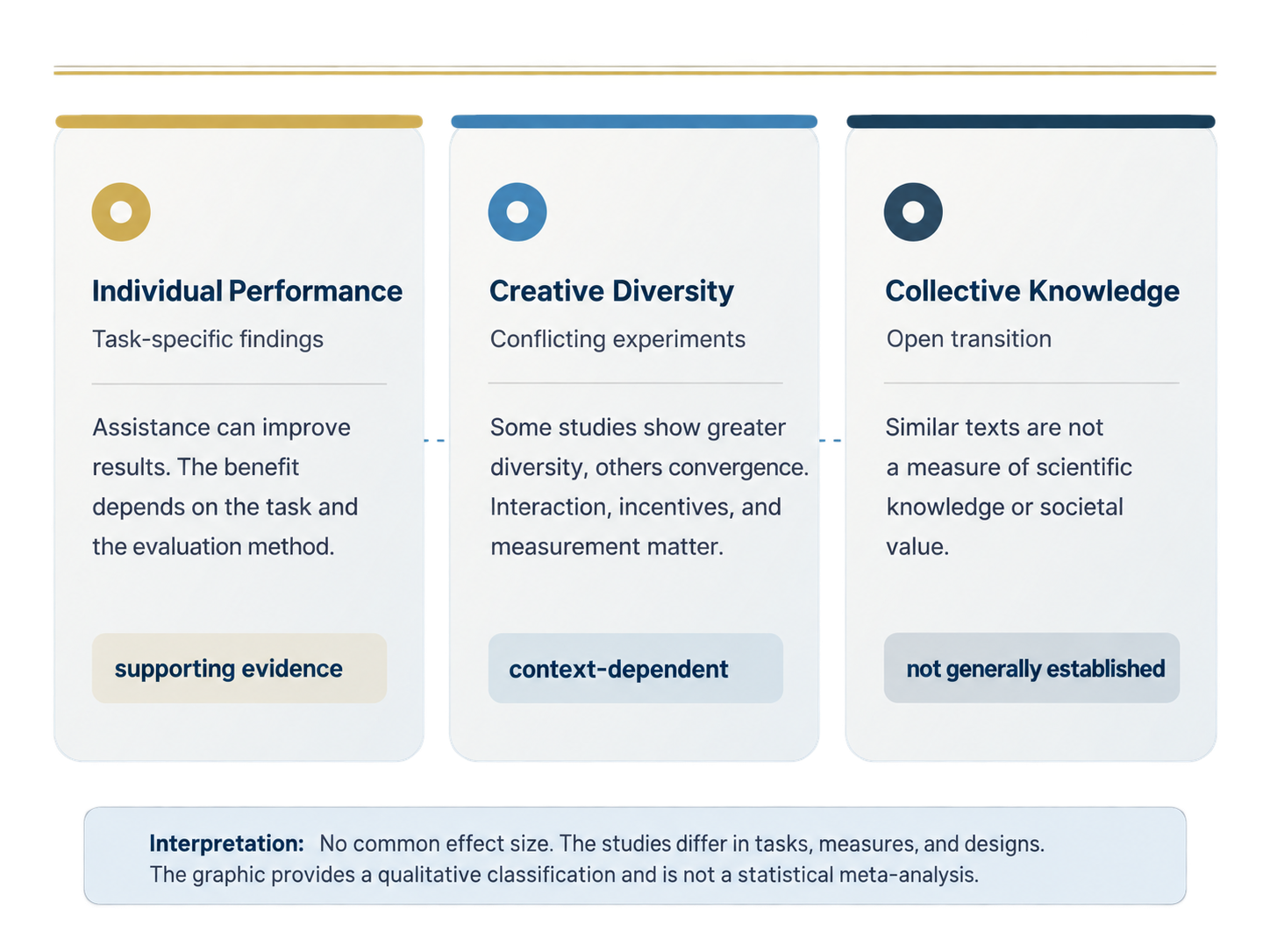
The distinction becomes even more important when many people use the same or similar AI systems. Even when individual users produce better work, a group's results need not become more varied. Research into AI-assisted creativity includes cases of higher individual evaluations alongside increased similarity, as well as studies in which the diversity of prompts, interaction patterns or incentives affected collective outcomes. These experiments mostly examine creative products under specific conditions. The similarity of short texts cannot, by itself, establish the quality of scientific discoveries or the condition of a society. Individual capability and collective epistemic gain must remain separate objects of assessment.
This distinction raises institutional questions. Who can access capable systems, scientific literature and verification tools? Which abilities are needed to assess their results critically? Which research questions receive institutional support, and which are neglected? Who controls the data, tools and decisions in sensitive environments? Could technical dependencies, standardised practices or an expanding volume of generated material narrow independent thinking in the very places where AI is expected to expand it?
These are not merely rules imposed after the technology has been built. Social and institutional conditions shape which problems are pursued, how systems are designed, what is considered a success and whether results can be examined publicly. A local AI system may give its operator greater technical control, but it is not automatically secure, inclusive or environmentally sound. AI is not necessarily the right tool for every task. A conventional algorithm, a better organisational process or a deliberate decision not to automate may sometimes be more appropriate.
Cultural acceleration as an open question
Seen in this light, the notion of AI as a cultural accelerator becomes more demanding. It does not simply mean producing more texts, programs, images or scientific publications in less time. Acceleration is not synonymous with progress. A more interesting possibility is that people can engage with knowledge differently, cross disciplinary boundaries, test questions together and develop ideas that previously lay beyond their practical reach.
Whether this leads to a diverse, responsible cultural development depends on additional conditions. These include reliable methods for checking claims, the capacity for justified disagreement, meaningful choices about technology, access to knowledge and institutions that reward more than speed or immediately measurable output. The freedom not to use AI also matters. A society does not automatically become more capable of development because it possesses more technical options. It must be able to understand, assess and choose among them responsibly.
This refines the central question. Instead of asking only whether AI will replace, surpass or make people more efficient, this paper asks under which social, institutional and technical conditions AI may expand collective human epistemic capacity, and what would be needed for this expansion to support diversity, autonomy and responsible development. The focus is neither the capability of one model nor an inevitable trajectory of technological progress. It is the relationship between human curiosity, exploratory collaboration, verifiable knowledge and social organisation.
The next chapters examine scientific assistance and exploratory processes before considering empirical counterevidence and the limits of individual gains. The main emphasis then shifts to the societal conditions under which newly accessible possibilities may become shared knowledge. Cultural acceleration remains a possibility to be examined, not a result assumed in advance.
Access to Knowledge, Competence and Scientific Assistance
Scientific questions build on observations, existing research, methods and unresolved contradictions. Before a defensible hypothesis can emerge, researchers must establish what is already known, how different fields use particular concepts and which claims have withstood scrutiny. Accessing and evaluating this knowledge is demanding even for specialists. For people entering an unfamiliar field, it may be the first major obstacle.
AI offers one possible form of assistance. It can help identify and organise the knowledge relevant to a research question. This does not remove the need for scientific education or years of research experience. It does raise the question of whether people can reach a point of meaningful understanding sooner, compare established approaches and identify justified next steps. The potential benefit is not only time saved. It may also be access to questions that were previously beyond someone's practical capabilities.
From available information to a defensible research question
Information is not the same as knowledge, and access to a source is not evidence that its significance has been understood. Scientific work requires more than locating documents that share a topic or keyword. Researchers need to distinguish central from peripheral evidence, identify incompatible definitions, evaluate methods and recognise uncertainty. A language model can provide a preliminary map of a field, but that map must be checked against actual publications and the specific question being investigated.
AI-assisted retrieval may reduce the effort of finding potentially relevant material. It cannot guarantee that the retrieved literature is complete or that the selected context is the right context. A fluent synthesis may conceal omissions, outdated claims or unsupported connections. Citations must lead to identifiable sources, and statements about those sources must reflect their actual findings. The capacity to identify plausible connections is useful only when those connections can subsequently be examined.
The distinction matters most in interdisciplinary work. Similar terms can refer to different concepts across disciplines, while different terms may describe related processes. An assistant may suggest links that a researcher has not considered. This can create a productive starting point, but the intellectual work of evaluating the link remains necessary. The same system that helps identify an overlooked connection may also propose one that falls apart under closer examination.
Scientific assistance as a verifiable division of labour
Scientific assistance becomes easier to assess when its functions are separated. A first function is access and orientation, including searching literature and mapping terminology. A second is analysis and comparison, in which methods, arguments and results are examined. A third is exploration and hypothesis development, which may generate new questions or alternative models. A fourth is verification and feedback, which tests proposed claims through suitable formal, computational or empirical methods.
These functions have different evidential requirements. Search results are not validated conclusions. A plausible hypothesis is not an established finding. A computational output is not necessarily a proof, and a biological prediction is not clinical evidence. Verification must be appropriate to the subject. In mathematics, formal proof checking may be required. In software development, tests and reproducibility matter. In experimental science, hypotheses must confront data generated under defensible conditions.
The important issue is not whether one AI model can perform all four functions. Often it should not. Search tools, databases, conventional algorithms, simulation systems, proof assistants and laboratory procedures may each be better suited to particular tasks. People need enough understanding and control to know which tool is being used, on what evidence it relies and how its output can be challenged. Human responsibility cannot be reduced to approving the final sentence of a generated answer.
A concrete example of AI-assisted research
The Robin research system reported by Ghareeb and colleagues illustrates both the promise and the limits of specialised AI assistance. The system combined components for processing research literature, developing hypotheses and analysing results within an iterative scientific workflow. Human researchers contributed to the investigation and experimental work. The study reported laboratory findings relating to proposed candidates in a research programme on dry age-related macular degeneration. These were in vitro results, not evidence of clinical effectiveness in patients. Ghareeb et al. 2026.
This example matters because the system's proposals did not remain purely textual. They were connected to experimental procedures capable of supporting or contradicting the hypotheses. At the same time, the case does not establish that a general-purpose AI can independently conduct science across disciplines. It reflects a specific research setting, a specialised workflow, access to tools and data, and human scientific judgement.
The reported comparisons of time and effort also require care. Estimates of the hours a human researcher might otherwise have spent are not the same as a controlled experiment comparing equivalent independent research teams. Nor do savings in one part of the workflow demonstrate a proportional reduction in total scientific cost. The study shows a concrete path for combining machine assistance with experimental investigation. It does not validate a universal productivity multiplier or an autonomous scientific authority.
Assisted performance is not acquired competence
One of the most important questions concerns what a person learns while using AI. Completing a task with assistance can improve immediate performance without creating the ability to solve a similar task independently. The user may understand the answer, only part of the procedure, or neither. Long-term competence involves recognising limitations, transferring knowledge, evaluating alternatives and acting without relying on the same prompt or system in every situation.
A useful distinction is therefore between tool-enabled capability, developed understanding and independent judgement. These may reinforce one another but need not do so. AI could support learning by explaining methods, exposing alternative perspectives and providing feedback. It could also encourage dependence if users accept plausible responses without examining their foundations. The empirical research reviewed for this paper does not establish a general long-term effect on independent competence. That question requires direct learning and transfer studies.
This is also a matter of educational design. A system that optimises for obtaining the correct answer may support different behaviour from one that encourages the learner to justify a claim, identify uncertainty or attempt a solution before receiving assistance. The distinction is not a moral rejection of convenient tools. It is a question of which capability an educational process is meant to develop.
More research output does not automatically mean more knowledge
Hao, Xu, Li and Evans examined large-scale patterns in scientific publication and AI-tool adoption. Their findings link AI use to advantages in individual scientific output or impact measures while also reporting a narrowing of the collective range of research topics. The study is observational and should not be read as a universal causal demonstration. Hao et al. 2026.
The finding is relevant because it separates what happens to individual researchers from what happens to the diversity of the scientific enterprise. A researcher may become more productive or visible while the aggregate distribution of questions shifts towards a narrower set of topics. The same evidence does not show that all AI-supported science becomes less valuable or that every field is affected equally. It does, however, challenge the assumption that improving individual performance necessarily broadens collective inquiry.
Publication counts, citation indicators, topic diversity and validated discoveries capture different things. Each has limitations. Greater output may reflect more work, better tools or changing publication behaviour. Topic concentration may be efficient in some contexts and restrictive in others. An empirical assessment must therefore specify what is being measured and what kind of epistemic or social benefit the measure can reasonably support.
From access to the ability to judge knowledge
Scientific assistance is most consequential when it changes not only how quickly information is found but also how questions can be formulated, tested and reconsidered. For that to happen, people need ways of identifying the evidence behind answers and of choosing verification methods suited to the problem. Access without judgement creates new dependencies. Judgement without access can leave valuable inquiries beyond practical reach.
The transition from assisted work to independent competence remains open to empirical investigation. It is not resolved by the existence of advanced tools, by an isolated successful case or by broad productivity statistics. The question leads directly to exploration: how do new possibilities actually emerge, and how can an exploratory process distinguish genuine findings from plausible variations?
Exploration, Reproduction and the Emergence of New Possibilities
AI-generated content can appear novel while drawing heavily on familiar patterns. That observation has prompted justified concern about replication, conformity and a growing volume of similar-looking output. Yet reproduction and exploration should not be treated as opposites in which one is always bad and the other necessarily good. Reusing established methods may be efficient and appropriate. Exploring alternatives becomes valuable when the question itself is uncertain, when established approaches are inadequate or when unexpected connections deserve investigation.
The distinction matters for this paper's original motivation. The aim of working with a local AI agent system was not simply to automate a predetermined sequence of operations. It was also to examine what might become possible when an idea is implemented, the implementation reveals new constraints and those constraints lead to new questions. This is an exploratory process, not evidence that the resulting system has already achieved its intended goals.
Implementing an idea can change the question
A conventional description of efficiency assumes that a task, a target and appropriate success criteria are known in advance. In exploratory work, some of these elements change. A first attempt may reveal that the problem was described incorrectly, that important dependencies were overlooked or that a different approach is more promising. The next step cannot always be specified before the earlier one has been examined.
Consider an AI-assisted technical project. It may begin with a question about which model to use. The choice quickly becomes related to model behaviour, memory, context selection, tool interfaces, hardware constraints, privacy, verification and the division of responsibility between humans and automated components. Each finding changes what needs to be considered next. Some questions become narrower and easier to test. Others expose assumptions that the initial plan never addressed.
This kind of development can occur without AI. What makes AI relevant is its potential role in reducing the practical cost of investigating alternatives, accessing unfamiliar terminology, drafting testable proposals and bringing perspectives from different disciplines into view. Whether that potential improves the quality or originality of the final result depends on the subsequent work. Generating more proposals is not itself evidence of better exploration.
What counts as a new possibility?
Several concepts need to remain distinct. Variation is a difference between outputs. Novelty means that an output differs in some relevant way from what is already known or expected. Exploration is the process of searching among possibilities, potentially changing the questions or criteria used. Knowledge requires an appropriate form of justification or verification. A practical possibility is an insight or approach that can be developed into a responsible course of action.
These concepts are connected, but there is no automatic progression from one to the next. A novel combination may initially seem useless and later prove important. An apparently ordinary improvement may make an essential practical difference. Counting suggestions or measuring semantic distance is therefore not sufficient to assess exploratory AI use. An adequate assessment should also ask which proposals were investigated, how they were tested, which errors could be ruled out and whether the work opened meaningful paths that were previously inaccessible.
The current creativity literature has limits here. Many studies use short writing tasks, lists of ideas or measures of textual similarity. These methods can illuminate particular aspects of variation and evaluation, but they tell us much less about how durable technologies, scientific theories or culturally significant works develop over time. Moving from creative material to justified and reusable knowledge is a distinct research challenge.
For a practical assessment of exploration, at least four questions are useful. Did the process produce an alternative that was not previously under consideration? Did it change the formulation of the problem? Was the proposed connection tested with a method suited to the claim? Did the result create a durable option for further inquiry or action? These are analytical questions, not a validated universal scale of exploratory quality.
The design of collaboration shapes the search process
The studies reviewed here suggest that the effects of AI cannot be separated from how people interact with it. Ashkinaze and colleagues used a dynamic experiment to examine how exposure to earlier ideas affects subsequent human ideas. Under conditions involving high passive exposure to AI-generated suggestions, measured collective semantic diversity increased, without an equivalent increase in individual originality ratings. This was a bounded idea-generation experiment, not an open scientific research programme. It nevertheless indicates that the composition of the material people encounter can influence collective outcomes. Ashkinaze et al. 2025.
Research by Shiiku and colleagues and by Jo and Raghavan similarly draws attention to interaction conditions. In Shiiku's experimental setting, mixed human–AI networks differed from AI-only networks on certain diversity measures in later rounds. Jo and Raghavan found that incentives for originality could change how participants used AI and affect the diversity of results in a controlled writing task. Neither finding proves that mixed groups are generally superior or that well-designed incentives eliminate all convergence. They indicate that task design, feedback and expectations can shape creative behaviour. Shiiku et al. 2025; Jo & Raghavan 2026.
Wan and Kalman investigated whether prompting AI to adopt diverse personas could reduce similarity in human–AI ideation. Their results provide a limited indication of possible design choices, not a general solution. A statistically non-significant difference does not establish equivalence between conditions and cannot demonstrate that homogenisation has been reliably prevented. Wan & Kalman 2026.
These studies vary in tasks, measures and interaction designs. Their findings cannot be merged into a single effect estimate for exploratory agent systems. Taken together, they motivate a more specific question: under what conditions does AI-supported interaction widen the range of possibilities that people genuinely investigate, and under what conditions does it encourage users to converge on similar proposals?
From a proposal to a tested investigation
The distinction between generating possibilities and producing reliable knowledge becomes clearer when suggestions encounter an external test. The Robin research system discussed in Chapter 2 provides a limited but instructive example. Specialised components supported literature analysis and biomedical hypothesis development. Researchers then investigated selected candidates experimentally. The reported results were in vitro findings and did not demonstrate clinical benefit. Ghareeb et al. 2026.
The important feature for this chapter is the feedback loop between a proposed explanation and an experiment. A hypothesis may fail, new data may reveal a faulty assumption, or a result may prompt another line of inquiry. This illustrates a possible mechanism of AI-assisted scientific exploration. It does not establish that such systems will independently produce discoveries in every field or complete entire research programmes without domain expertise.
The same distinction applies to mathematics and technology. AI may suggest a solution, an unexpected connection or a promising proof strategy. Appropriate tests, calculations, formal proof checking or empirical observations are needed to establish whether the proposal is valid. Strong claims that AI systematically enables previously inaccessible mathematical discoveries require specific, independently examinable evidence. The eight primary studies reviewed here do not justify that generalisation.
Exploration is therefore not simply a process of producing possibilities. It includes rejecting unsupported options, recognising constraints and revising initial assumptions. When a system can generate large numbers of plausible proposals, the quality of evaluation becomes more, not less, important.
Not every task requires generative AI
An investigation into expanded human agency would contradict itself if it assumed that every problem must be solved with a language model. Some tasks are better addressed through database queries, deterministic algorithms, established simulations or formal rule checks. Other tasks benefit from open linguistic exploration, especially where the question is still unclear, multiple fields need to be compared or competing interpretations must be considered.
In a local agent system, this distinction could become a basic architectural principle. A language model would not replace every other method. It could help interpret a request, identify suitable tools or explain results, while the selected tools and their outputs remain independently testable. This is a proposed design approach, not an empirically established outcome of an already operating system.
The choice of method is also related to sovereignty. A person who needs to understand, reproduce or independently verify an outcome requires different system properties from someone who needs a rapid preliminary suggestion. An exploratory workflow may improve by deliberately avoiding probabilistic generation at certain stages. Innovation is not synonymous with maximising AI use. It can depend on the appropriate combination of human judgement, specialised tools and technical methods.
When exploration might contribute to cultural development
The discussion so far has centred on an individual's question: which new approaches can be recognised and investigated when AI changes access to information, alternative proposals and verification methods? A wider individual space of possibilities says little, however, about which possibilities will matter beyond that person. An idea must be communicated, criticised, reproduced or placed in a shared body of work. Other people need opportunities to test its assumptions and reach independent, possibly conflicting conclusions.
This makes the idea of cultural acceleration more demanding. Production of variations may increase without generating new knowledge. Alternatively, it may become easier to connect previously separate fields or involve people in inquiries that were once inaccessible to them. Whether these benefits materialise depends not only on system performance but also on practices of verification, learning conditions, diverse perspectives, resources and institutional decisions about which results deserve attention.
Such processes are not necessarily positive and do not require AI in every case. The reviewed studies do not demonstrate an overall acceleration of cultural development. They illuminate particular relationships among exposure, interaction, variation and testable research. They support a reasoned research perspective: AI should not be judged only by task speed or the novelty of its suggestions, but also by whether it helps people formulate new questions, compare alternatives critically and develop knowledge that others can build upon.
This leads to a further problem. Collaboration may be productive and stimulating for individuals while making the results of many users more similar. Conversely, greater diversity of outputs may not improve their quality. Chapter 4 therefore examines why individual success and collective outcomes can diverge, and how counterevidence challenges simplistic narratives of progress.
Why Individual Success Does Not Automatically Produce Collective Benefit
When AI improves performance on a demanding task, that is initially an individual gain. A person may access difficult literature, develop design ideas or formulate a more precise scientific hypothesis. The preceding chapters examined why such assistance may matter for exploratory work. But an improvement in individual performance does not establish that a group, research discipline or society knows more as a result.
The distinction is central to assessing cultural development. More texts, proposals or publications do not automatically make a society's knowledge more diverse or reliable. It also matters whether competing approaches emerge, errors can be identified and corrected, findings are intelligible to others, and dissenting perspectives remain available. The transition from individual capacity to collective epistemic benefit therefore requires investigation in its own right.
The studies reviewed here show effects that should be examined together rather than forced into a single narrative. Some controlled experiments find better individually rated creative work alongside more similar outputs. Others find greater collective diversity under particular conditions or suggest that interaction design matters. The two meta-analyses examined for this project suggest a mean tendency towards homogenisation, while also indicating substantial variation across tasks and settings. None of these findings disproves the possibility of expanding individual capabilities. They demonstrate why individual and collective outcomes must be distinguished.
When better individual performance produces more similar results
Doshi and Hauser investigated the effect of generative AI suggestions on short-story writing. Participants who could draw on AI-generated ideas received higher ratings on certain dimensions of creativity, but the stories also became more similar across participants. Individual benefit and reduced diversity in the overall set of outputs appeared together. Doshi & Hauser 2024.
This challenges the assumption that improvements in individual quality necessarily increase variety across a group. Evaluating each participant separately may reveal an improvement. Comparing their outputs may reveal a narrower range. That does not mean the stories became identical or worthless, nor does it show that every kind of AI support reduces cultural diversity. It does show that individual quality and collective difference are separate measures.
Moon, Green and Kushlev compared human-written and GPT-4-generated texts in a college-admissions essay setting. They found lower semantic diversity among the AI-generated texts. This complements research into convergence but is not equivalent to a study of people using AI interactively in an open writing process. Comparing human and machine-generated corpora differs methodologically from testing human–AI collaboration. Moon, Green & Kushlev 2025.
Hao and colleagues provide a broader perspective on science. Their observational analysis links the adoption of AI tools with gains in individual scientific output or impact and a narrowing of the collective research focus. Unlike the short creative experiments, this research examines historical publication data and the distribution of research attention. It does not provide a universal causal estimate, but it reinforces the need to consider collective effects beyond individual productivity. Hao et al. 2026.
What the meta-analyses actually show
Holzner, Maier and Feuerriegel reviewed research on generative AI and creativity and conducted a meta-analysis. Their results distinguish creativity assessed at the level of an individual's output from diversity across multiple outputs. An average benefit from assistance on certain individual creativity measures can coexist with a negative finding for collective diversity. Importantly, the diversity synthesis rested on a much smaller evidence base than the broader creativity analysis. Its estimate must not be treated as a precise universal effect applying to all tasks or populations. Holzner et al. 2025.
De Rooij and Biskjaer conducted a systematic review and meta-analysis focused on homogenisation in human–AI co-creation. The April 2026 preprint examined for this project reported 19 studies and 61 effect sizes, with an average tendency towards homogenisation and substantial variation across studies and tasks. A journal version was subsequently published. The detailed figures cited by this project remain tied to the preprint where a full version-by-version table comparison has not been performed. de Rooij & Biskjaer 2026.
These two meta-analyses cannot be treated as independent replications. Some primary studies overlap. They also operationalise outcomes differently, and an effect expressed as lower diversity cannot be compared naively with one expressed as greater homogenisation. The fact that their directions are compatible does not justify simply combining their numerical estimates. Their contribution is to identify a meaningful risk, not to establish an inevitable collective decline under all forms of AI use.
Why contrary evidence matters
A balanced assessment must consider studies that report more nuanced or contrasting effects. Ashkinaze and colleagues found greater measured collective diversity under one condition of high passive exposure to AI-generated ideas. Other experiments suggest that network composition, incentive structures or variation in generated perspectives can affect the outputs. These results do not cancel the homogenisation findings, but they question whether convergence is an intrinsic and unchangeable property of every human–AI interaction. Ashkinaze et al. 2025; Shiiku et al. 2025; Jo & Raghavan 2026.
The experimental conditions matter. Some studies examine passive exposure, others active prompting or repeated interaction. Some evaluate semantic distances, others ratings of novelty or creativity. Tasks range from short stories to iterative idea generation. A positive effect on one measure cannot be transferred automatically to another. Non-significant results should not be presented as proof that an intervention works equally well as its comparator.
The practical implication is not that a single prompting strategy can solve homogenisation. It is that collective outcomes depend partly on what users encounter, the incentives under which they work and the structures through which suggestions are selected, challenged and developed. These relationships deserve further study in realistic, long-term settings.
Diversity matters but is not the same as knowledge
Collective diversity is important because a group that considers only similar options may overlook alternatives. Yet diversity alone does not establish the truth, usefulness or significance of what is produced. A large collection of mutually different but unsupported ideas does not automatically represent a scientific advance. Nor must a field's temporary concentration on a fruitful problem be harmful in every setting.
Semantic similarity, scientific novelty and epistemic quality are different constructs. A text can be linguistically different while repeating an old idea. A shared technical vocabulary can make two genuinely competing hypotheses look similar. A novel scientific claim may be important even if its wording resembles an established one. These distinctions limit the transfer of findings from short creative tasks to the longer processes of scientific discovery or cultural development.
A stronger assessment should consider not only how many different proposals are produced, but also whether alternatives undergo meaningful scrutiny, results can be independently verified and new findings become available to others. The original question about expanded human possibilities therefore leads to institutional mechanisms of criticism, validation and collective uptake.
Designing collective knowledge processes becomes a task in its own right
If AI supports individuals while also shaping the distribution of collective outputs, its societal value cannot be assessed by individual benchmarks alone. Organisations and research communities need to consider which questions receive attention, how disagreement is preserved, whether outputs remain traceable to evidence and how results are shared and reviewed.
None of the studies examined here demonstrates a general causal pathway from a particular governance intervention to long-term cultural progress. Their settings and outcomes are too diverse. They do, however, challenge a simple productivity narrative and show why interaction design and collective processes warrant explicit attention.
This turns the inquiry towards society's enabling and constraining conditions. Education affects the ability to challenge a plausible answer. Research institutions influence which problems are rewarded. Technical infrastructure affects who can inspect, modify or replace a system. Governance determines how responsibilities and decisions are organised. These conditions do more than regulate finished AI applications. They also influence what people attempt to discover in the first place.
The Societal Conditions: Who Can, May and Should Explore New Possibilities?
The potential to expand human knowledge is not determined by technical performance alone. The environments in which people learn, conduct research, work and make decisions influence which questions they can pursue, which claims receive attention and which results can be tested and shared. AI systems are used in schools, research groups, public administrations, businesses, cultural institutions and private projects. These settings differ in their goals, resources, responsibilities and tolerance of error. It is not sufficient to assess the technical characteristics of a system in isolation.
The societal dimension is therefore central rather than supplementary. A capable assistant can lower barriers to entering a field while leaving other barriers untouched. People may still lack time, financial resources, reliable data, suitable education, institutional support or the right to inspect and challenge consequential decisions. A system may broaden one person's choices while reinforcing existing dependencies elsewhere. The question is how conditions shape the emergence, scrutiny and practical value of new possibilities.
Three theoretical perspectives help examine these mechanisms without collapsing them into one theory. Amartya Sen's capability approach distinguishes resources from the real freedoms people can exercise. Helen Longino's social epistemology examines the conditions under which scientific criticism can be effective. Elinor Ostrom's work on institutions offers concepts for analysing rules, actors and available courses of action. These perspectives address different questions. Their combination is a proposed interdisciplinary synthesis, not an empirically validated unified causal model.
Access alone does not create capability
Technical access is an important starting condition but not a complete measure of what someone can do. Two people may possess the same AI tool yet differ substantially in their capacity to formulate questions, assess outputs, use suitable methods and turn the result into an action they consider valuable. The distinction is consistent with the capability approach: possessing a resource is not equivalent to having a real opportunity to achieve a valued outcome. Sen (1999); Robeyns, The Capability Approach.
The capability approach does not directly prove any effect of AI. It provides a conceptual reason to examine the conditions under which assistance becomes usable freedom. Relevant conversion factors may include education, language, accessibility, domain knowledge, institutional permission, time, reliable infrastructure and the availability of independent verification tools. The same nominal access may therefore lead to very different practical possibilities.
This also affects how digital inclusion should be assessed. Counting subscriptions or available interfaces does not establish equal opportunities for participation in inquiry. A more informative evaluation would ask which people can define their own questions, select suitable tools, challenge answers and act on what they learn. These are proposed evaluative dimensions, not a completed empirical measurement model.
Survey evidence also shows that AI adoption is uneven across population groups. OECD publications report differences in usage patterns, while other OECD work examines the skills needed to work with AI. These are distinct types of evidence and should not be merged into one causal claim. Observed differences in adoption do not by themselves explain their causes or determine the long-term effects on capability. OECD 2026, adoption; OECD 2026, skills.
Education must develop more than tool use
Education faces a distinction between completing a task successfully and developing an understanding that can be used independently. An AI assistant can help explain concepts, compare approaches or generate feedback. A learner may nevertheless accept an answer without understanding its assumptions. Conversely, structured interaction may provide opportunities for asking questions that a learner could not yet formulate unaided.
For educational practice, the relevant goal is not simply to maximise AI-assisted performance. It is to develop the ability to question a result, judge its evidence, recognise uncertainty and transfer understanding to new situations. This requires suitable exercises, assessment methods and expectations. Whether particular teaching practices lead to durable gains is an empirical question requiring evidence beyond the creativity experiments reviewed in this whitepaper.
UNESCO's guidance on generative AI in education and research addresses questions of responsible use, human capacities and institutional safeguards. It is relevant as guidance, but it is not experimental proof that specific interventions improve learning. UNESCO 2023.
The idea of critical capability also has an institutional dimension. Learners need permission and practical opportunities to disagree with a system. They need to know what it means to check a source, reproduce a procedure and choose not to use an AI tool when it is inappropriate. The capacity for justified disagreement is a more demanding educational outcome than mere familiarity with prompts.
Research institutions influence which questions are pursued
Research does not occur in a vacuum. Funding priorities, publication incentives, peer review, reputational pressures and the allocation of equipment and staff influence what researchers attempt and what kinds of work they can sustain. Institutions may support exploratory inquiry, but they can also reward rapid output, familiar methods or topics with predictable results. If AI reduces the effort required to produce certain outputs, existing incentives may amplify the production of those outputs rather than broaden the scope of inquiry.
The observational findings of Hao and colleagues make this possibility relevant, but they do not isolate the causal contribution of every institutional incentive. Hao et al. 2026. To establish how funding systems or publication practices interact with AI adoption, further research would need to examine the institutions, their decisions and plausible alternatives.
Ostrom's institutional analysis offers a useful way to move beyond a list of abstract conditions. Rules define which actors may act, what information they receive, which decisions they can make and how outcomes are assessed. Applied cautiously to AI-supported research, this directs attention to who controls infrastructure, who can select questions, how results are evaluated and what happens when an established approach is challenged. Ostrom 2005.
This is an analytical use of institutional theory, not a claim that Ostrom's framework has already been shown to predict the effects of generative AI in scientific organisations. Different institutions may respond to the same technology in different ways. What matters is to formulate examinable mechanisms rather than assume that a named framework guarantees an outcome.
Scientific quality assurance is also an institutional achievement. Replicability, reproducibility, transparent methods and critical review require resources and agreed practices. The National Academies' report on reproducibility and replicability addresses these broader standards of scientific work. It does not demonstrate the effectiveness of any specific AI governance intervention. National Academies 2019.
Cultural and scientific diversity require room for disagreement
Diversity is not only the statistical difference between generated outputs. It also concerns whether different perspectives can enter a discussion, whether criticism can affect decisions and whether marginal or inconvenient questions can receive serious attention. A community may produce varied content while excluding meaningful dissent. It may also use a shared vocabulary while conducting rigorous, independent inquiry.
Longino's social epistemology treats scientific knowledge as shaped by critical interaction within communities. Her work directs attention to channels for criticism, the capacity to respond to objections, shared standards and the conditions under which participation in criticism is possible. Longino 1990; 2002. These are theoretical resources for understanding collective knowledge, not direct measurements of AI effects.
For AI-assisted work, the implication is that a system's ability to produce alternatives is insufficient if users or institutions cannot evaluate and contest them. A credible process should make it possible to inspect relevant evidence, identify divergent assumptions and change a conclusion when stronger reasons emerge. Human oversight is meaningful only when it includes access to information and room to act on the assessment.
The creativity experiments in Chapter 4 show why interaction conditions deserve attention. They do not tell us whether an entire society has become more inclusive or epistemically pluralistic. Any such judgement would require evidence about participation, power, institutions and the distribution of opportunities to influence collective decisions.
Digital sovereignty means more than owning a server
Digital sovereignty is often associated with where computing takes place or who owns infrastructure. These questions matter, particularly in sensitive settings. Yet local operation alone does not establish meaningful control. A system may run on privately controlled hardware while depending on opaque models, unavailable documentation, fragile interfaces or suppliers that cannot be replaced. Conversely, an externally hosted service may offer some forms of portability, auditability and contractual protection while still creating significant dependencies.
The more demanding question is what an individual or organisation can actually decide and verify. Relevant issues include access to data, the ability to change suppliers, control over configuration, knowledge of system limitations, logging and auditability, reversibility of decisions and the ability to suspend an unsafe process. Control also depends on human competence and organisational responsibilities. Without these, technical ownership may offer little practical freedom.
This brings the capability and institutional perspectives together without treating them as identical. Access to a controllable tool can expand choices, but the value of those choices depends on the user's abilities, institutional rules and the quality of available information. The relationship is plausible and worth investigating. It is not established by the existence of one local AI architecture.
The local agent system that helped motivate this whitepaper remains an exploratory project context rather than empirical proof of a sovereign operating model. Its relevance is conceptual: it makes choices about model deployment, tool selection, data handling and verification visible. A sound comparison between local and hosted architectures must consider security, cost, sustainability, maintainability, operational expertise and the actual ability to act independently.
Control must work organisationally
A principle such as human oversight has little practical meaning if nobody can recognise a system change, assess its impact or decide on an appropriate response. Organisations need information that allows them to understand relevant changes in data, models, interfaces and operating conditions. They also need defined responsibilities and means of intervention. Governance therefore involves the design of operational decision processes, not simply a declaration that the human remains in charge.
The NIST AI Risk Management Framework provides a structured approach to governance and risk management. Its functions include Govern, Map, Measure and Manage. UNESCO's Recommendation on the Ethics of Artificial Intelligence adds a normative perspective on rights, human agency and societal responsibility. These are guidance and governance frameworks, not evidence that a particular control has produced a measured cultural or epistemic benefit. NIST 2023; UNESCO 2021.
The distinction matters because rules, documentation and monitoring can themselves impose costs. More governance paperwork does not automatically make an organisation capable of exercising control. A measure is useful when it supports a real decision, makes failures detectable or provides a meaningful option for action. Its effectiveness should be assessed against those functions.
The potential contribution to scientific exploration is indirect but important. If researchers can identify dependencies, inspect the sources behind an answer and replace unsuitable components, they may be better able to pursue questions independently. Whether a particular governance arrangement actually produces this effect remains open to empirical study.
Societal benefit is a question of distribution and evaluation
Even if AI improves individual competence and enables better scientific work, society must still consider who benefits, who bears costs and which outcomes count as valuable. New opportunities may be unevenly distributed. Some groups may gain access to expertise while others face new barriers or lose control over processes that affect them. Infrastructure and model operation also involve economic, organisational and environmental costs.
These considerations cannot be settled by a model benchmark. Nor can they be resolved simply by measuring the number of innovations or publications. They require normative judgements about autonomy, participation, pluralism, responsibility and fairness, informed by evidence about real effects and distribution. Reasonable values may conflict. Improving access can create new privacy risks; increasing oversight may increase costs; concentrating expertise may improve a particular research effort while narrowing opportunities elsewhere.
The capability approach helps articulate the difference between resources and substantive freedom. Social epistemology addresses the quality of shared inquiry. Institutional analysis examines the rules and incentives under which actors operate. None is a complete substitute for the others. The value of bringing them together lies in identifying distinct questions that a societal evaluation of AI must answer.
From technical possibilities to shared capacities for action
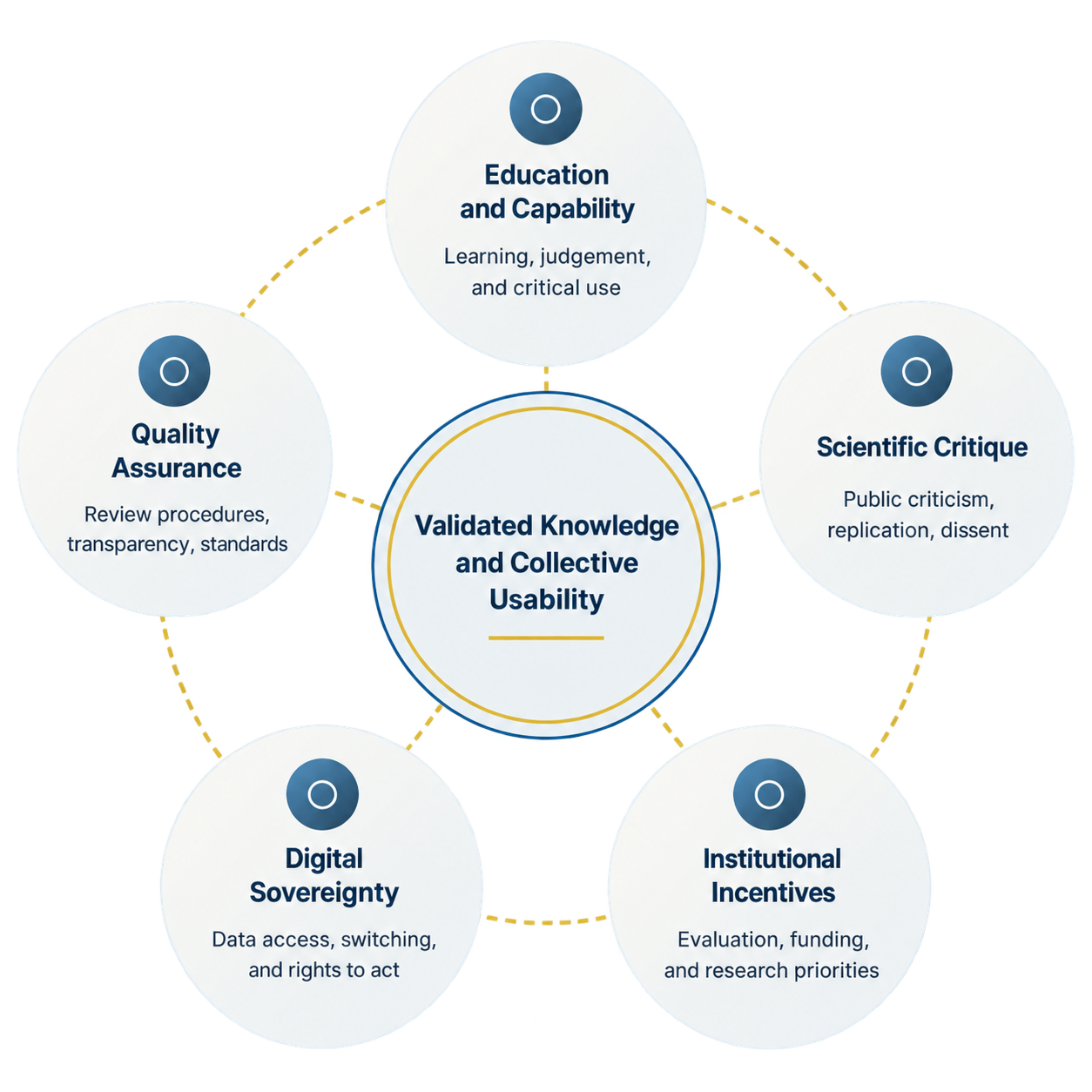
The institutional perspective can be summarised through three mechanisms. Capability and justified disagreement concern whether people can turn technical access into independent understanding and effective participation. Research incentives and quality assurance concern which questions receive attention and how claims become credible. Control and the ability to change course concern whether actors can inspect, modify, replace or discontinue the systems on which their work depends.
These mechanisms influence the emergence of new questions as well as what happens to resulting ideas. They are not merely filters applied after an innovation has appeared. Educational settings shape the questions people learn to ask. Research institutions influence which hypotheses are worth pursuing. Infrastructure and governance affect which methods can be used and whether their outcomes can be checked independently.
The proposed relationships remain theoretical and context-sensitive. The available evidence does not demonstrate that introducing any one institutional measure will produce a general increase in collective knowledge or cultural progress. The contribution of this chapter is to make the relevant mechanisms explicit and distinguish the evidence needed to assess them. The conclusion now returns to the central inquiry and examines how these conditions connect across different epistemic transitions.
A Cultural Accelerator: Under What Conditions?
The preceding chapters examined the possibility that AI could expand what individuals can investigate and create. They also showed why technical performance, scientific knowledge and social progress cannot be treated as equivalent. Empirical findings support certain individual benefits and identify risks of collective convergence. Other studies suggest that interaction conditions can alter outcomes. The institutional analysis describes additional conditions that may affect whether these possibilities become reliable, shared and socially valuable. These findings do not amount to proof of general cultural acceleration.
An appropriately limited conclusion must therefore distinguish what the reviewed research establishes, what a conceptual synthesis makes plausible and what depends on social values. The central contribution offered here is an organising framework for examining the critical transitions between AI-assisted activity and possible societal gain.
A bounded framework for the relationships
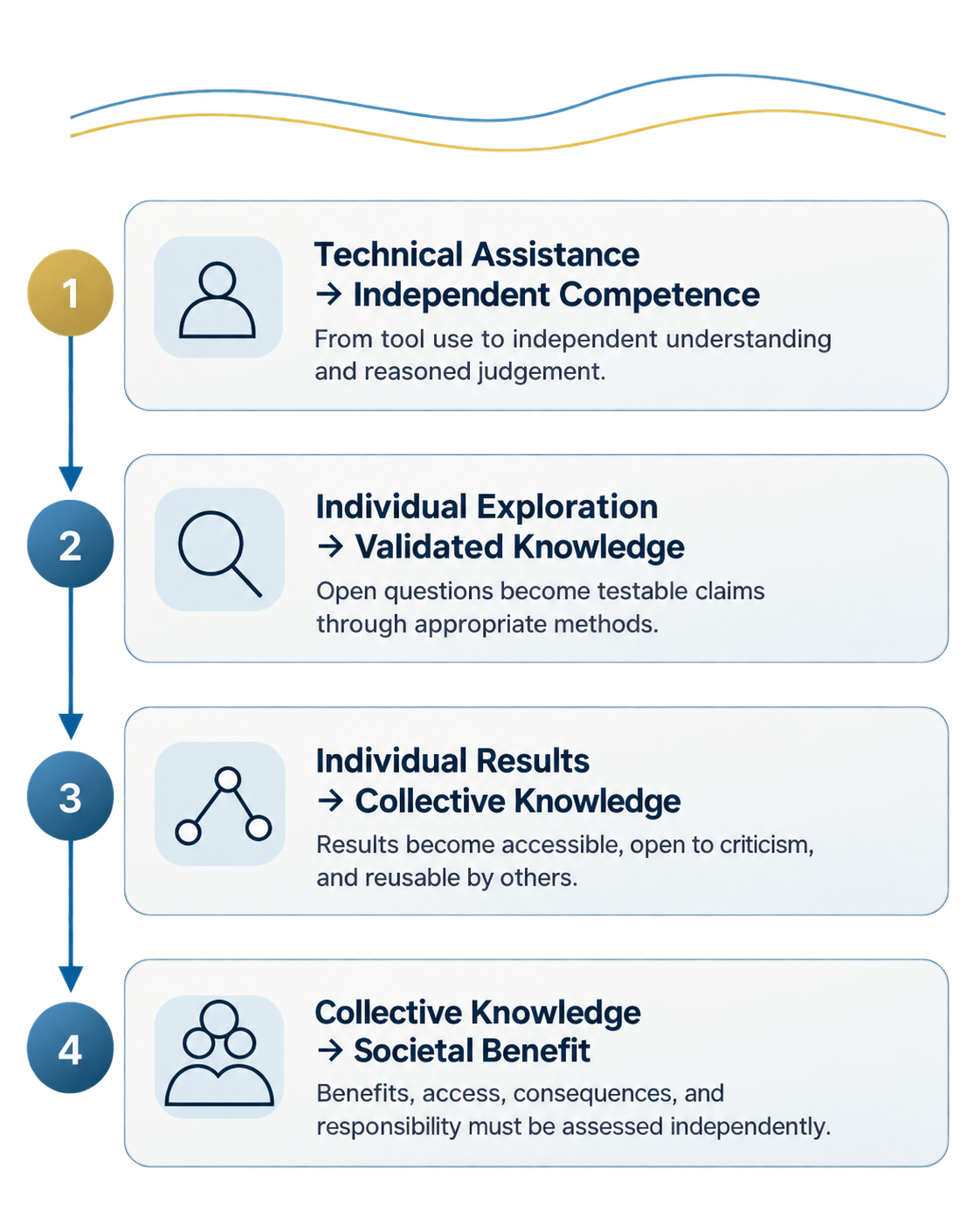
The framework identifies four epistemic transitions. They are not a mandatory linear sequence and have not been validated as a single causal chain. They are distinct relationships that need different forms of evidence.
Transition 1: Technical assistance to independent competence. A tool may support a task without producing durable understanding. The relevant question is when assistance contributes to learning, transferable skills and independent judgement. Access to the tool and success on the immediate task are not sufficient measures. Learning outcomes and transfer would need to be tested directly.
Transition 2: Individual exploration to validated findings. AI may help generate alternatives and hypotheses. Whether those proposals become knowledge depends on appropriate verification. Experimental, computational, formal and domain-specific methods play different roles. The Robin research example demonstrates a concrete form of interaction between suggestions and laboratory testing, but does not establish a general law of AI-driven discovery.
Transition 3: Individual results to collective knowledge. A finding gains a different status when other people can examine, challenge, reproduce or build upon it. The mechanisms include communication, critical exchange, quality assurance and institutional recognition. Social epistemology provides relevant theoretical resources, while the reviewed creativity research only partially addresses the collective processes involved.
Transition 4: Collective knowledge to societal benefit. Even reliable, widely shared knowledge does not automatically produce equitable or responsible outcomes. The distribution of capabilities, access, autonomy, costs and consequences must be assessed. This transition combines empirical questions about effects and distribution with normative judgements about what should count as progress.
The transitions can occur in different orders or interact. Social rules and technical infrastructure shape what people can explore before any findings emerge. A practical innovation can have value without first becoming a recognised scientific result. Shared knowledge may influence individual learning, and societal choices may redirect research questions. Feedback and adverse effects must therefore be examined rather than hidden behind a simple process diagram.
An associated set of conditions and mediating mechanisms helps explain what may influence each transition. Technical access, available resources, skills, institutional rules and control rights form part of the conditions. Searching, exploration, justified criticism, verification and collaboration form part of the mechanisms. Results must be distinguished at the individual, epistemic and collective levels. A final normative assessment considers capabilities, autonomy, participation, plurality and responsibility.
This four-level description is not claimed as an entirely new causal theory. The proposed focus on epistemic transitions and institutional mediating conditions is an interdisciplinary synthesis of ideas and evidence with different origins. Its originality relative to existing scientific frameworks has not been exhaustively demonstrated. The framework's value must therefore be judged by how clearly it identifies gaps, avoids invalid inferences and supports more precise future investigations.
What the research supports and what remains open
The reviewed primary studies provide evidence of selected individual performance gains, differences in creative output diversity and the influence of particular experimental conditions. The two partially overlapping meta-analyses indicate a meaningful risk of homogenisation on average for the outcomes they studied, alongside substantial variation. The Robin case documents a specialised workflow in which AI-supported hypotheses were connected to laboratory investigation. The bibliometric analysis by Hao and colleagues identifies a tension between individual research indicators and collective topical breadth. Each result is limited by its study design and measured outcome.
The evidence does not demonstrate that AI invariably promotes creativity, invariably narrows knowledge or generally accelerates cultural development. It does not establish that a local agent system produces superior research or that greater access necessarily leads to lasting personal expertise. It cannot show that any particular governance framework causes a society to become more knowledgeable, autonomous or fair.
Theoretical perspectives nevertheless help organise plausible relationships. Sen's capability approach distinguishes resources from effective freedom. Longino examines the institutional and communicative conditions of criticism. Ostrom supports analysis of rules, positions and available actions. Their contributions are complementary at the level of questions, not interchangeable evidence for the same mechanism. Joining them is a conceptual exercise whose explanatory claims remain open to empirical testing.
The framework can guide more specific future research. Do AI-assisted learners retain and transfer competence when the assistant is removed? Which verification arrangements improve the reliability of AI-generated hypotheses? How do incentives and channels for criticism affect the diversity and quality of collective inquiry? Under what conditions do local control, data portability or supplier choice genuinely expand independent research options? Which groups benefit from the resulting knowledge, and who bears the costs?
These questions are more useful than a single broad assertion that AI is either a cultural accelerator or a cultural threat. They also avoid turning methodological caution into a refusal to reach any conclusion. The evidence supports bounded findings. The conceptual argument connects them to conditions that still require direct investigation.
A conversation with Socrates as a thought experiment
The figure of Socrates returns here for a different reason than in the introduction. The question is no longer simply what someone could discover with access to advanced assistance. It concerns the distinction between access to information, sound reasoning and the legitimate authority to decide.
Imagine a dialogue with a hypothetical system whose factual range and analytical performance far exceed those of a human participant in many domains. Even if it identified stronger empirical arguments or detected inconsistencies more effectively, that would not automatically give it the authority to decide which values should govern a community. Epistemic performance and normative legitimacy are different questions.
Nor would the system's greater apparent confidence make a claim reliable without evidence. The relevant response is to examine the basis of the claim, the methods behind it and the opportunity for meaningful disagreement. A human decision maker needs more than the formal right to approve a result. They need sufficient information, institutional support and practical freedom to question it.
This is a bounded philosophical thought experiment. It is not a prediction about the emergence, consciousness or moral status of superintelligent AI. It illuminates a distinction that already matters for current systems: greater ability to generate or evaluate information does not confer democratic, ethical or political legitimacy.
How could cultural benefit be recognised?
An assessment of cultural development needs more than rising output figures. Relevant indicators might include whether people can formulate and investigate questions they previously could not pursue, whether findings withstand independent scrutiny, whether diverse lines of inquiry remain viable and whether others can access and use the resulting knowledge. These are possible assessment dimensions, not a completed measurement instrument.
The question of benefit also extends to the freedom to choose methods, contest assumptions and redirect a project when evidence changes. Cultural progress cannot be equated with the speed of producing artefacts or the volume of generated material. A technically impressive result may offer limited benefit if it cannot be verified, if it creates inaccessible dependencies or if its consequences are borne unequally.
A more demanding notion of acceleration would ask whether processes of inquiry, criticism and responsible collective learning become more effective. Even then, faster change is not automatically better change. Normative evaluation is necessary because societies reasonably disagree about priorities, acceptable risks and the distribution of gains and burdens.
The possibility of discovering new possibilities
The starting point of this whitepaper was simple: what happens when a person takes an idea, begins to implement it with AI assistance and discovers questions that were not visible at the beginning? The examination of scientific research and institutional conditions has not replaced that motivation. It has made its assumptions and limits more explicit.
AI can support access to information, the comparison of approaches and the development of proposals. Under particular research conditions, those proposals can be connected to independent verification. Controlled studies also show that assistance can improve selected individual outcomes while making collective outputs more similar. Other findings indicate that interaction conditions can alter the distribution of results. Whether any of this yields lasting competence, collective knowledge or societal progress remains contingent on further mechanisms and conditions.
The most defensible conclusion is therefore conditional. AI's possible contribution to cultural development depends not only on expanding what individuals can do, but also on how new possibilities are examined, challenged, shared and translated into real opportunities for others. Technical performance is relevant but not sufficient. Scientific verification, meaningful criticism, accessible capabilities and institutional freedom to act all matter, although their joint effects are not established as one universal causal relationship.
The decisive question is not simply how fast AI becomes. It is which human and societal possibilities emerge through its deliberate design and use, and how we can determine whether those possibilities represent progress.
The short citations in the main text refer to publicly identifiable scientific publications or institutional sources. Where the project examined a preprint and a subsequent journal version exists, the distinction is made explicit. The inclusion of a later publication record should not be mistaken for an independent re-analysis of all underlying datasets or tables.
Empirical primary studies
- Ashkinaze, J., Mendelsohn, J., Li, Q., Budak, C., & Gilbert, E. (2025). How AI Ideas Affect the Creativity, Diversity, and Evolution of Human Ideas: Evidence From a Large, Dynamic Experiment. Collective Intelligence 2025. https://doi.org/10.1145/3715928.3737481. Research version analysed: arXiv:2401.13481v3.
- Doshi, A. R., & Hauser, O. P. (2024). Generative AI enhances individual creativity but reduces the collective diversity of novel content. Science Advances, 10(28), eadn5290. https://doi.org/10.1126/sciadv.adn5290.
- Ghareeb, A., et al. (2026). A multi-agent system for automating scientific discovery. Nature, 655, 497–505. https://doi.org/10.1038/s41586-026-10652-y. Claims about Robin are limited to the reported laboratory and analytical conditions. They do not establish clinical efficacy.
- Hao, Q., Xu, F., Li, Y., & Evans, J. (2026). Artificial intelligence tools expand scientists’ impact but contract science’s focus. Nature, 649, 1237–1243. https://doi.org/10.1038/s41586-025-09922-y. An earlier research version from 2025 was analysed; the study is retrospective and observational.
- Jo, N., & Raghavan, M. (2026). Incentives shape how humans co-create with generative AI. arXiv:2604.03529. https://arxiv.org/abs/2604.03529. Version analysed: arXiv:2604.03529v1.
- Moon, K., Green, A. E., & Kushlev, K. (2025). Homogenizing effect of large language models (LLMs) on creative diversity: An empirical comparison of human and ChatGPT writing. Computers in Human Behavior: Artificial Humans, 6, 100207. https://doi.org/10.1016/j.chbah.2025.100207. Comparison of human and AI-generated text corpora, not interactive assistance.
- Shiiku, S., Marjieh, R., Anglada-Tort, M., & Jacoby, N. (2025). The Dynamics of Collective Creativity in Human-AI Hybrid Societies. Version analysed: arXiv:2502.17962v3. https://arxiv.org/abs/2502.17962v3.
- Wan, Y., & Kalman, Y. M. (2026). Diverse AI personas can mitigate the homogenization effect in human-AI collaborative ideation. Computers in Human Behavior: Artificial Humans, 8, 100289. https://doi.org/10.1016/j.chbah.2026.100289. Initially examined: arXiv:2504.13868v2. The updated publication identity does not imply an unrecorded re-analysis of all tables.
Meta-analyses and secondary evidence
- Holzner, N., Maier, S., & Feuerriegel, S. (2025). Generative AI and Creativity: A Systematic Literature Review and Meta-Analysis. Version examined: arXiv:2505.17241v1. https://arxiv.org/abs/2505.17241v1. The estimate for collective diversity rests on only a small subset of the included studies and must be interpreted in light of substantial heterogeneity.
- de Rooij, A., & Biskjaer, M. M. (2026). Does generative AI make us think alike? A systematic review and meta-analysis of homogenisation effects in human–AI co-creation. Behaviour & Information Technology, published online 31 August 2026. https://doi.org/10.1080/0144929X.2026.2726451. Version note: The April 2026 preprint (Homogenization pre-print v1.1.pdf) was used for the project's detailed quantitative assessment. At the level checked, the journal publication confirms 19 studies, 61 effect sizes, the mean homogenisation finding and variation by task. This does not establish complete correspondence between all tables across versions. The two meta-analyses overlap in their primary studies.
Theoretical foundations
- Longino, H. E. (1990). Science as Social Knowledge. Princeton University Press.
- Longino, H. E. (2002). The Fate of Knowledge. Princeton University Press. Additional reference: Stanford Encyclopedia of Philosophy, The Social Dimensions of Scientific Knowledge.
- Sen, A. (1999). Development as Freedom. Oxford University Press. A theoretical foundation for assessing substantive freedom and capabilities, not an empirical study of AI effects.
- Robeyns, I. (2025, updated version). The Capability Approach. Stanford Encyclopedia of Philosophy.
- Ostrom, E. (2005). Understanding Institutional Diversity. Princeton University Press. https://doi.org/10.1515/9781400831739. The 2005 edition is supported by bibliographic catalogue data; other dates may reflect later editions or digitisation. Additional reference: Ostrom Workshop, IAD Framework.
Institutional and normative sources
- National Academies of Sciences, Engineering, and Medicine (2019). Reproducibility and Replicability in Science. National Academies Press. https://doi.org/10.17226/25303. Recommendations for scientific practice, not direct evidence on the effectiveness of AI-specific incentive systems.
- OECD (5 June 2026). AI and skills: What we know so far. https://doi.org/10.1787/f843b352-en. Supports statements concerning skills and barriers to implementation.
- OECD (28 January 2026). AI use by individuals surges across the OECD as adoption by firms continues to expand. Separate source for differences in AI use across population groups.
- UNESCO (2021). Recommendation on the Ethics of Artificial Intelligence. Normative guidance, not causal evidence of effectiveness.
- UNESCO (2023). Guidance for Generative AI in Education and Research. Institutional guidance.
- NIST (2023). Artificial Intelligence Risk Management Framework (AI RMF 1.0). https://www.nist.gov/itl/ai-risk-management-framework. Governance framework, not an evaluation of individual interventions.
Limits of this evidence integration
The bibliography supports the paper's claims only within the contexts of the cited studies and theories. Experiments involving short writing or idea-generation tasks do not demonstrate long-term cultural development. Social epistemology, the capability approach and institutional analysis are related here as distinct theoretical perspectives, not as a single empirically validated causal model. Claims about the effects of particular institutional arrangements require additional testing. The whitepaper's conclusions are limited to the body of literature examined.