AI and the Expansion of Human Development Opportunities
Between ability, enablement and new interests
How new tools might not only extend what we can do today, but also influence the interests, experiences, and ways of thinking we develop in the future.
The Limits of Human Possibility
How many ideas never take shape because people lack the knowledge, time, or resources to pursue them? How many interests remain undiscovered because entering a particular field seems too demanding? And how many abilities might develop if the conditions for discovering them were different?
A person's development depends on more than the abilities they already demonstrate. Equally important are the experiences available to them, the questions they encounter, and the opportunities they have to pursue their own ideas. Human potential therefore cannot be assessed solely by what someone is capable of today.
Someone may have a strong sense for design without the technical expertise to develop a complex structure. Another person might discover a genuine interest in scientific relationships but never gain access to the methods needed to explore them. Others may never encounter the fields in which particular interests or abilities could emerge.
This does not imply that everyone possesses an unlimited range of hidden talents. Not every interest leads to a particular skill, and not every new experience has a lasting effect on personal development. It does, however, raise the question of how strongly our possibilities are shaped by the conditions under which we learn, work, and gain experience.
Specialisation as Both an Enabler and a Constraint
As scientific and technical disciplines have become more differentiated, specialised bodies of knowledge, methods, and professions have emerged. Many demanding activities require years of education, practical experience, and deep subject expertise. Such specialisation underpins a wide range of scientific and technical achievements. At the same time, it limits the number of fields any one person can explore in depth during a lifetime.
Someone trained in architecture does not automatically have extensive knowledge of materials science, computer science, or theoretical physics. Someone developing a musical idea may not know the technical methods required to investigate or realise it.
These limits do not arise solely from individual ability. Time, access to education, financial resources, and available tools also determine which ideas can be pursued. Opportunities for exploration and development may therefore remain out of reach, particularly at the boundaries between disciplines.
What We Do Not Yet Know About Our Own Potential
We often think about personal development in terms of interests that are already present. A person discovers an inclination, explores it more deeply, and develops related abilities.
But how can we know what other interests we might develop?
Interests need not exist before an experience takes place. They can also emerge when people encounter an unfamiliar subject, a new method, or a different way of thinking. Someone who has never had the opportunity to explore a field may not even recognise the questions or ideas it could inspire.
Limited experience may therefore prevent more than the development of existing abilities. It may also mean that new interests and ideas never arise.
These constraints affect people differently. Access to education, economic circumstances, social expectations, and technical infrastructure shape which experiences are realistically available. The question of unexplored potential thus has a social dimension as well as an individual one.
The abilities and interests a person develops in the future cannot be fully inferred from their circumstances today. Experiences they have not yet had may also influence that development.
The availability of capable AI systems is changing some of the conditions under which people can access knowledge and explore their own ideas. AI can help them understand unfamiliar fields, apply methods, and develop initial approaches to complex problems. Activities that once required extensive prior knowledge or specialist assistance may consequently become more accessible.
This leads to a further question:
What might happen to human development if people no longer had to master every necessary specialist method before they could begin exploring a demanding idea?
The significance of AI may extend beyond making existing tasks more efficient. People who can explore new fields and activities may encounter experiences from which further interests, questions, and abilities emerge.
To place this possibility in context, it is worth looking at history. Specific developments illustrate how human imagination, scientific knowledge, and the tools available at a particular time can be connected.
Knowledge, Imagination, and the Limits of Their Time
Human development takes place within the conditions of its time. The questions that can be investigated, the methods available, and the ideas that can be realised depend on more than individual ability.
History offers examples of people who expanded established boundaries of thought and action. What matters here is not only what they achieved, but also the conditions under which those achievements became possible. What might have happened if they had had access to additional fields of knowledge, methods, and technical tools?
That question cannot be answered retrospectively. It does, however, help us examine the relationship between human imagination and the means available to explore and realise ideas.
Socrates: The Importance of Asking the Right Questions
In the philosophical tradition, Socrates exemplifies a form of thinking whose strength lies less in accumulating knowledge than in critically examining supposed certainties.
In accounts preserved primarily by Plato and Xenophon, he challenges beliefs, examines concepts, and tests seemingly self-evident assumptions for contradictions. His significance therefore lies not only in the search for answers. Equally important is his ability to ask questions that challenge established views and open up new lines of thought.
Consider this approach in a time when far more scientific and philosophical knowledge is accessible. What additional connections might be examined? Which accepted beliefs might fail to withstand critical scrutiny?
The point is not to predict how Socrates would have used today's technologies. Rather, the thought experiment illustrates that access to knowledge and the ability to question it critically are two different conditions of human understanding.
A tool can provide additional information and perspectives. Whether these lead to new insights also depends on how people examine the information, connect different ideas, and develop conclusions of their own.
Leonardo da Vinci: When Imagination Meets Technical Limits
Few historical figures combine artistic design, scientific observation, and technical curiosity as strikingly as Leonardo da Vinci. His notebooks address anatomy, mechanics, geometry, and natural phenomena, among other subjects. They illustrate his sustained interest in connections between different fields of knowledge.
His technical investigations also show how an idea can reach beyond the available means of putting it into practice. A concept can be developed even when the materials, measurement techniques, or technical methods needed to test it do not exist.
What might Leonardo have explored if he had had access to additional modelling, simulation, or materials-analysis techniques?
Some of his ideas might have been tested earlier. Others might have been disproved by further evidence. Still others might have given rise to questions that would never have emerged without the ability to investigate them. We cannot infer specific additional inventions or historical achievements from this thought experiment.
The underlying relationship is nevertheless important: New tools can do more than make existing ideas easier to realise. They can also influence the process through which further ideas emerge.
When people test an idea, they gain information that can lead to additional questions and, in turn, further investigations. Technical possibilities can therefore influence not only whether an existing idea can be realised, but also which ideas a person develops next.
Albert Einstein: Imagination and Scientific Understanding
Albert Einstein illustrates another dimension of human understanding: the ability to approach established scientific assumptions from a new perspective. Thought experiments played an important role in his scientific work. They helped him investigate fundamental questions in physics and consider the consequences of theoretical assumptions. Such achievements depend on more than the amount of available knowledge. The questions a person asks, and the ability to see familiar relationships differently, also matter.
Yet Einstein, too, worked within the scientific and technical possibilities of his time.
What might it have meant if additional scientific findings, theoretical models, or complex calculations had been more immediately accessible for examination?
More information would not automatically have produced new scientific insights. Greater computational capacity cannot replace scientific originality or the critical testing of theoretical claims. Additional methods might nevertheless have made further investigations possible. Whether they would have produced new knowledge remains an open question.
How Tools Change Human Possibilities
These three historical figures represent different forms of intellectual achievement. Socrates illustrates critical inquiry, Leonardo the connection between observation and design, and Einstein the importance of theoretical imagination.
The influence of available tools, however, extends well beyond exceptional individuals. The microscope, for example, made structures visible that cannot be seen with the naked eye. It did not merely improve existing observations; it also contributed to new scientific questions and fields of investigation.
Similar developments can be seen in musical instruments. New instruments and techniques create additional ways of producing sound and expressing musical ideas. A new tool does not necessarily change a person's creative ability. Initially, it changes the forms of expression available to them.
New tools may therefore matter not only because they help highly qualified people work more effectively. They may also give a wider range of people access to activities that previously required extensive training or specialised technical resources.
This changes how their value can be understood. The relevant question is no longer only what people can do better or faster with them, but also what new experiences they make possible.
AI belongs within this history of human tools, but differs in important ways from many earlier technologies. Whereas numerous historical tools extended particular forms of perception, calculation, or design, modern AI systems can assist with a variety of intellectual activities. This broad applicability makes AI particularly relevant here. It can facilitate movement between fields without possessing universal expertise.
A concrete example helps illustrate how far this support might expand the activities people can undertake.
AI and the Expansion of Human Agency
Imagine a person who wants to develop a novel architectural structure.
They have a design concept and basic knowledge of their field. To examine the idea in greater detail, however, they would need additional expertise in programming, mathematical modelling, materials science, and technical simulation. Traditionally, they would have to acquire these skills themselves or collaborate with specialists. Both approaches are valuable, but require time, resources, and appropriate circumstances.
AI-assisted tools could provide a different starting point. The person could ask for explanations of fundamental principles, compare modelling methods, and develop initial code. They might then use appropriate specialist software to examine particular assumptions and design variants.
This would not establish that the structure had been technically validated or could be built. AI-generated calculations, code, and specialist claims can contain errors. Reliable assessment would still require suitable testing methods and the necessary expertise.
Nevertheless, one important condition changes: It can become possible to begin investigating an idea before independently mastering every specialist method it requires.
Deep expertise remains necessary in many contexts. What changes is the possibility of engaging with an idea in practice at an earlier stage.
The Difference Between Being Able to Do Something and Having It Made Possible
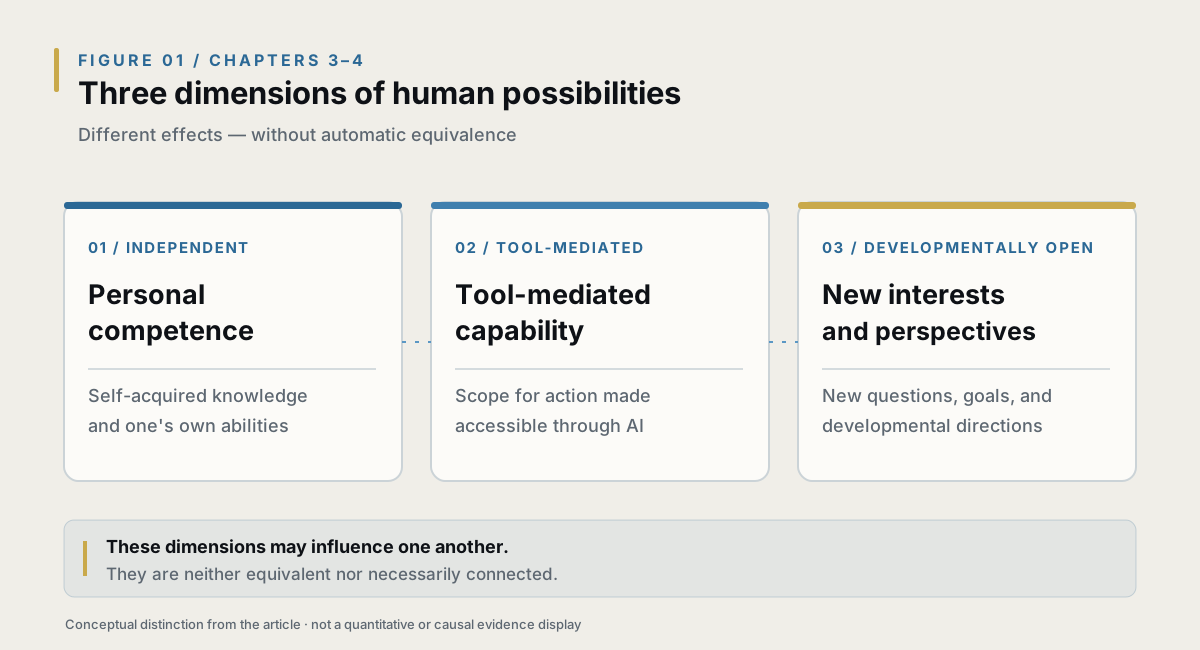
The architectural example illustrates an important distinction. A person may complete a demanding task with the help of a tool without necessarily acquiring the ability to carry it out independently. Using AI to write code does not mean the user has mastered the programming language. Creating a technical simulation model does not imply a full understanding of its mathematical and physical foundations.
Even so, this assistance can have value in its own right. We should therefore distinguish between the abilities a person possesses independently and the additional possibilities created through working with suitable tools. We refer to the latter as instrumental empowerment.
The capacity for sound judgement remains essential. When people do not fully master the specialist methods involved, they still need to define appropriate goals, critically assess results, and recognise the limits of their own understanding.
An expanded scope for action is therefore neither equivalent to independent expertise nor inherently less valuable. Both forms of human capability matter, but they serve different purposes.
When Learning and Doing Intersect
Access to knowledge changed long before generative AI became widely available. Digital libraries, research databases, search engines, and freely available educational resources already allow people to explore many fields independently.
The potential difference is therefore not simply that AI supplies information. Suitable systems can also help apply information to a particular question and develop initial practical approaches. In some situations, this could change the order in which learning and action occur.
Often, people first acquire foundational knowledge and then apply it to more complex tasks. In an AI-assisted investigation, a concrete idea can instead provide the starting point. Some of the methods required may only be explored during the work itself.
Problem-based learning is not new. AI could, however, make certain specialised activities easier to begin and thereby make these experiences accessible to more people. Whether this produces independent understanding depends on how people process the results and continue developing their knowledge.
Practical Possibilities and Technical Limits
AI does not perform equally well across all kinds of tasks. In an experiment involving 758 knowledge workers, Dell'Acqua and colleagues examined how AI affected performance on different tasks. Participants achieved better results on certain tasks within the capabilities of the AI configuration being studied. On a task outside those capabilities, AI assistance instead reduced performance [1].
These boundaries are neither universal nor permanent. They depend on the tasks examined and the properties of the system in use. The fact that AI makes a specialist method accessible does not mean that the method is being applied correctly. A convincing-looking result is not sufficient evidence of technical accuracy.
The way people work with AI can also matter. In a randomised study, Kestin and colleagues found that a purpose-designed AI tutor produced higher learning outcomes than the active-learning classroom comparison in the physics course examined [2].
Bastani and colleagues, by contrast, found that relatively unrestricted AI assistance could improve performance on mathematics practice exercises while impairing subsequent independent test performance. A more structured tutoring version did not show the same statistically significant disadvantage relative to the control group [3].
These studies address different learning environments. Together, they illustrate why better task performance should not be equated with learning.
Return to the architectural idea. The person's original aim was to explore a structure. During the process, however, they encounter methods and relationships that were previously unfamiliar.
They might discover a particular interest in material properties, recognise connections between biological structures and engineering principles, or develop a new design question from an initial simulation.
The person starts with a known idea. Technical assistance brings them into contact with unfamiliar knowledge and experiences from which further interests might emerge. The original idea may then have done more than lead to a better investigation. It may have changed the questions the person goes on to pursue.
This brings us to the central concern of this article: How might newly accessible experiences influence a person's subsequent development?
The Reciprocal Development of People and AI-Assisted Experience
When people explore unfamiliar activities, they encounter new questions and relationships. These experiences can lead to interests that, in turn, motivate further investigations and the development of additional abilities.
The initial use of a tool could therefore set a developmental process in motion whose later direction was not foreseeable at the outset.
We are interested in AI not only as a tool for completing existing tasks, but also as a potential influence on the interests, abilities, and ideas people develop through the experiences it makes accessible.
When Experiences Give Rise to New Interests
People do not pursue only interests they already recognise. Some interests emerge through an encounter with a new subject or unfamiliar activity. Research on interest development provides one way of explaining this. In their four-phase model, Hidi and Renninger describe how an initially triggered situational interest can, under certain conditions, develop into a more enduring individual interest [4].
Initial exposure alone is not enough. Among the relevant factors are whether curiosity persists, further questions arise, and the person returns to the subject repeatedly.
Someone who uses AI to investigate a technical model for the first time might become interested in a method initially regarded as no more than a means to an end. A single investigation may change very little. If the person continues pursuing the questions it raises, however, a longer-term specialist interest could develop.
This would go beyond the successful completion of the original task. The experience might have influenced which goals the person subsequently chooses.
AI does not directly create such interests. It may make the experiences from which they emerge more accessible.
How Experiences Can Become Independent Abilities
New interests are only one possible consequence. A further question is whether additional experiences can help people develop abilities and ways of thinking of their own. During an AI-assisted activity, a person may focus only on the result. Alternatively, they may compare assumptions, investigate discrepancies, and gradually work through the methods used.
David Kolb's theory of experiential learning offers a relevant conceptual point of reference. It describes learning through the interaction of concrete experience, reflective observation, conceptual understanding, and further experimentation [5].
An initial AI-assisted investigation could thus become the starting point for further learning. The person compares results, tries to explain differences, and tests their understanding in additional situations. Through this process, they may develop knowledge that goes beyond the original assistance.
Kolb's theory describes a general mechanism of learning. Whether and under what conditions generative AI actually supports such longer-term processes remains a separate empirical question.
When New Abilities Open Up Further Possibilities
New interests can motivate people to acquire knowledge. That knowledge may make further activities possible, which in turn raise new questions.
The significance of this interaction is not limited to the fact that acquired skills can enable more demanding tasks. Additional experiences may also change how a person approaches future questions. They may notice connections that were previously invisible to them, develop different interests, or start linking fields of knowledge they had once considered separate.
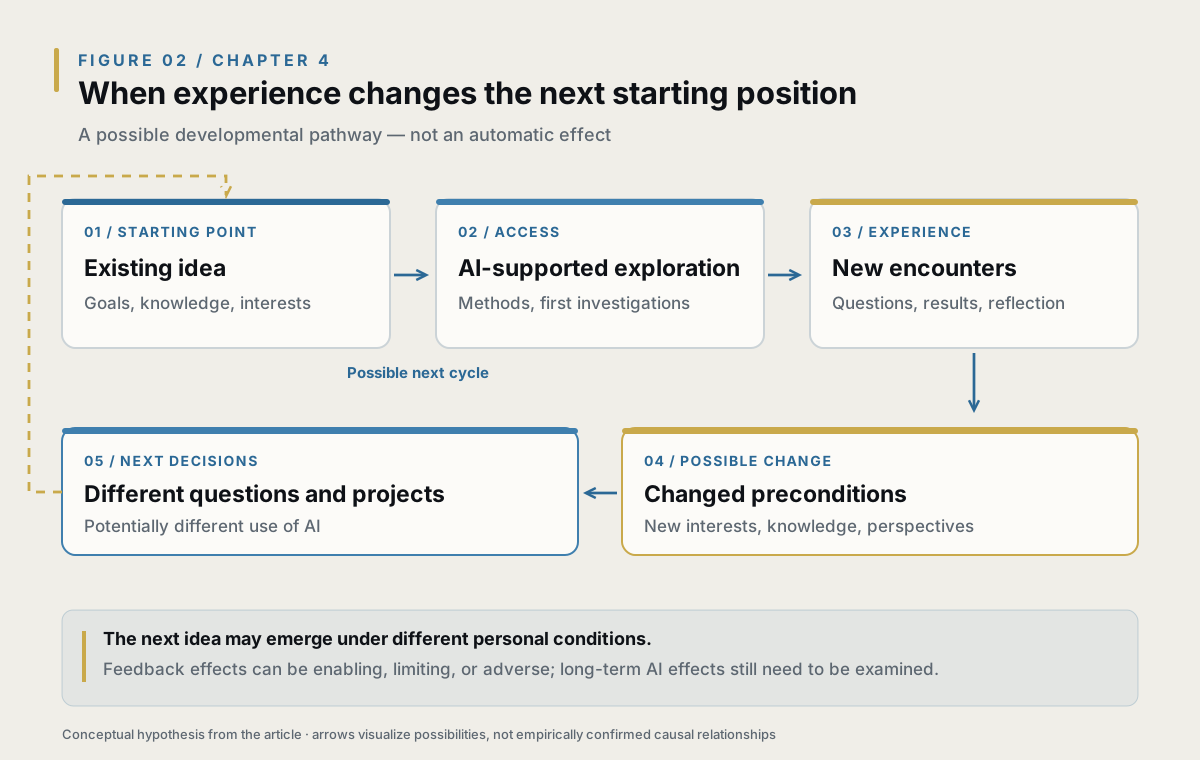
This changes their personal starting point for subsequent decisions. Consider the architectural example again. The person began by wanting to investigate a particular structure. In doing so, they encountered material properties and mathematical models.
If this experience has changed their interests, they may choose their next project for different reasons. Instead of pursuing only the original form, they might investigate a new question in materials science.
Their use of AI could change as well. They ask different questions, draw on new knowledge to assess results more precisely, and may recognise additional methods relevant to their work.
The next idea therefore emerges under different personal conditions from the first. New experiences may lead to changing interests. These influence further decisions and activities, which may generate yet more experiences.
Such a process need not follow a straight path or be consistently beneficial. Some interests fade. Others lead into new areas without producing additional skills. Dependence on technical support may also increase.
The central feedback mechanism is that experiences may do more than produce results: they may also change the conditions under which people develop their future questions, goals, and possibilities for action.
Across several such steps, individual developmental paths could emerge that were neither planned nor foreseeable at the beginning.
This does not establish that AI promotes such processes over the long term. The proposed mechanism does, however, show why the successful completion of an individual task may capture only part of its possible significance.
The Importance of How People Work with AI
The experiences arising from AI use also depend on how people engage with the system. One person may accept completed outputs. Another may use the same technology to compare alternatives, formulate questions, and explore unfamiliar methods. Both approaches can be useful, but they create different opportunities for personal engagement.
Research on metacognitive strategies offers a relevant indication. In a field experiment, Sun and colleagues found positive effects of large language model assistance on employee creativity. These effects were especially pronounced among participants with stronger metacognitive strategies [6].
The finding does not establish a universal rule for how AI should be used. It does, however, help explain why existing knowledge, individual motivation, and the design of the interaction matter alongside the technical capabilities of the system.
Not every delegated task has to produce a personal learning gain for AI use to be worthwhile. People use tools to save time, reduce effort, and make work easier. These are benefits in their own right.
At the same time, repeatedly delegating particular activities may mean that the corresponding skills are practised less often. Mixed outcomes are therefore possible.
Someone might pursue increasingly complex projects with AI, discover new specialist interests, and simultaneously become more dependent on assistance for certain technical methods.
Creative assistance can also have different effects. In an experiment involving short-story writing, Doshi and Hauser found that AI-generated ideas could improve evaluations of individual stories. At the same time, the AI-assisted stories became more similar to one another [7].
Improved individual results and greater diversity of ideas are therefore distinct measures. Human development cannot be reduced to a single scale of progress.
People cannot fully know which interests, abilities, and ideas they might develop under different conditions. An unfamiliar field can raise new questions. An apparently simple experience may lead someone to broaden an existing interest or reconsider personal goals.
We use the term developmental openness to describe this fundamental openness of individual developmental pathways. It is not a property created by artificial intelligence. People have always discovered interests and developed abilities through new experiences.
Our hypothesis is narrower: AI might create additional opportunities for experience by making previously difficult-to-access fields, methods, and activities easier to explore.
This could also alter the conditions under which people make subsequent decisions about their own development.
The next chapter considers how far such processes can currently be examined empirically.
What Research Shows and What Remains Open
Empirical studies have examined particular effects of AI on human performance, learning, and creativity. They do not all measure the same thing. Some assess how people complete specific tasks with AI. Others test what they can subsequently do on their own. Still others examine changes in creative outputs or self-reported cognitive activity.
The conclusions these studies support depend on the abilities, situations, and time periods they actually measure.
Task Performance and Personal Skill Development
Improved task performance initially shows that technical assistance can be effective under particular conditions. It tells us much less about whether people acquire independent abilities or develop lasting new interests.
The Kestin and Bastani studies discussed above illustrate the difference between successful AI-assisted task completion and learning demonstrated without assistance.
Within their respective experimental designs, these studies support causal conclusions about certain measured effects of the assigned support. They do not establish general long-term developmental effects.
A strong result during AI use may be largely enabled by the system. Successfully completing a comparable task later without AI provides more direct evidence of personally acquired knowledge.
Even a test administered immediately afterwards, however, is not sufficient to establish lasting skill development. This would also require examining whether knowledge is retained over time and can be applied in other situations.
Cross-domain transfer is particularly relevant here. Can someone independently apply insights gained through an AI-assisted experience to a different kind of problem? Research addressing this question could help determine whether the effects extend beyond the original activity.
Changes in Cognitive Work and Creative Performance
Assessing AI's effects is also difficult because it can change the nature of people's cognitive work. Lee and colleagues studied 319 knowledge workers across 936 reported instances of AI use. They found, among other things, an association between greater confidence in AI and lower self-reported critical-thinking effort [8].
Participants also described a shift in their activities. Rather than developing all information independently, they devoted more attention to reviewing, assessing, and integrating it.
On the one hand, particular skills might receive less practice when associated cognitive steps are delegated. On the other, reducing effort in some areas may free attention for other demanding activities.
The study does not show which changes predominate over the long term. Because it relies substantially on self-reports, it does not directly demonstrate a loss or gain in ability.
The distinction between observed association and causal effect is especially important. A correlation between confidence in AI and reported cognitive effort does not, by itself, show that confidence causes reduced effort or that long-term skill losses follow.
The amount of cognitive work performed independently is therefore not a sufficient measure of the overall quality of human–AI collaboration.
Related measurement challenges arise when evaluating creative work. For the short-story task it examined, the Doshi and Hauser study distinguishes between the quality of individual outputs and the diversity of the stories produced overall.
The experiment supports conclusions about the immediate effects of the AI-generated ideas made available in that setting. It did not establish how individuals' imaginative capacities developed over the longer term.
Someone may create a more compelling piece of work with AI without necessarily developing greater independent creative ability. Conversely, encountering an unfamiliar method could spark a creative interest even if the quality of a particular result does not immediately improve.
Such changes cannot be adequately assessed by evaluating a single task.
The Open Question of Long-Term Developmental Pathways
The central concern of this article is the development of new interests and abilities beyond individual tasks. We want to understand whether AI may give people access to experiences from which developmental paths emerge that they might otherwise never have pursued.
The empirical studies considered here do not yet provide a comprehensive answer. This does not mean that long-term human–technology interactions have never been studied. Nor does our selection of literature amount to a systematic review of everything published in the field.
For the specific relationship between generative AI, newly accessible experiences, and longer-term individual developmental pathways, important questions remain open on the basis of the studies examined here.
One promising approach would be to follow people over an extended period as they pursue self-directed, cross-disciplinary projects. Researchers would need to examine not only which tasks participants complete with AI, but also whether they subsequently ask different questions, pursue unfamiliar interests, and develop abilities beyond their original goals.
Longer observation alone would not be enough. Three issues would need to be distinguished: How do interests and abilities change over time? Which changes can genuinely be attributed to AI-assisted experiences? And what significance do these changes have for the person's subsequent development?
Answering the second question would require appropriate comparison conditions and careful consideration of other influences.
Not every lasting change automatically represents an expansion of human potential. Someone may develop new interests without acquiring additional specialist skills. They may adopt different working methods without becoming more independent overall. Personal goals may also change in ways that cannot clearly be classified as improvements or setbacks.
Existing research provides useful evidence about particular effects and possible mechanisms. It does not yet establish comprehensively whether, or under what conditions, AI-assisted experiences open up new long-term developmental pathways.
This limit to what can currently be concluded informs the final perspective.
The Long-Term Perspective on Human Development
The starting point was a question: How many ideas, interests, and abilities remain undiscovered over a human lifetime because knowledge, time, and opportunities for action are limited?
The historical perspective illustrated how available tools can influence human knowledge and creative activity. Today's AI systems show that, under certain conditions, demanding activities may become accessible before people independently master every specialist method involved.
Yet the deeper significance of this change may not lie solely in the results it produces.
It may also lie in what people discover along the way.
We often judge a tool by how well it supports a particular task. This is a reasonable approach, but it focuses mainly on goals we already know.
What happens when people encounter unfamiliar questions and experiences while working towards those goals?
With AI assistance, someone might use an unfamiliar method for the first time and discover a new interest in the process. That interest could lead to further ideas or independent projects.
Such a development is not inevitable. It does, however, illustrate why intelligent tools should not be evaluated solely by their immediate performance.
Human possibilities can expand in different ways. People may acquire abilities of their own, undertake more complex activities with suitable tools, or develop new interests. What matters is which possibilities actually emerge and what they mean for a person's subsequent development.
The Conditions for Responsible Human–AI Collaboration
Research findings show that AI can have different effects depending on the task, the way it is used, and the circumstances of the individual.
This does not mean that people should continue carrying out as many activities as possible without technical support. The purpose of tools is precisely to make tasks easier and open up new possibilities.
What matters is that people pursue goals deliberately, assess results appropriately, and recognise the limits of both their knowledge and the systems they use.
Responsibility does not rest solely with individual users. The design of AI systems, the quality of educational opportunities, and conditions within companies and public institutions also shape which experiences and developmental opportunities become accessible.
There is a wider social dimension as well.
New tools might do more than make highly qualified people's work easier. They could enable others to explore fields of knowledge and activity that had previously been out of reach.
Whether this leads to more widely shared opportunities for development also depends on education, infrastructure, economic circumstances, and the quality of the systems available.
Whether AI opens up new long-term paths of human development, and under what conditions, remains a question for scientific investigation.
Yet even the possibility of such a development broadens the perspective from which we should evaluate intelligent tools.
What matters is not only which tasks they take over or which results they improve. Equally important is the question of which previously unknown interests, abilities, and ideas people might develop through using them.
The future of artificial intelligence is therefore also a question of which possibilities for development people may be able to unlock through it.
[1] Dell’Acqua, F., et al. (2026). Navigating the Jagged Technological Frontier: Field Experimental Evidence of the Effects of Artificial Intelligence on Knowledge Worker Productivity and Quality. Organization Science, 37(2), 403–423. https://doi.org/10.1287/orsc.2025.21838
[2] Kestin, G., Miller, K., Klales, A., Milbourne, T., & Ponti, G. (2025). AI tutoring outperforms in-class active learning: An RCT introducing a novel research-based design in an authentic educational setting. Scientific Reports, 15, Article 17458. https://doi.org/10.1038/s41598-025-97652-6
[3] Bastani, H., et al. (2025). Generative AI without guardrails can harm learning: Evidence from high school mathematics. Proceedings of the National Academy of Sciences, 122(26), e2422633122. https://doi.org/10.1073/pnas.2422633122
[4] Hidi, S., & Renninger, K. A. (2006). The Four-Phase Model of Interest Development. Educational Psychologist, 41(2), 111–127. https://doi.org/10.1207/s15326985ep4102_4
[5] Kolb, D. A. (1984). Experiential Learning: Experience as the Source of Learning and Development. Prentice-Hall.
[6] Sun, S., Li, Z. A., Foo, M.-D., Zhou, J., & Lu, J. G. (2025). How and for whom using generative AI affects creativity: A field experiment. Journal of Applied Psychology, 110(12), 1561–1573. https://doi.org/10.1037/apl0001296
[7] Doshi, A. R., & Hauser, O. P. (2024). Generative AI enhances individual creativity but reduces the collective diversity of novel content. Science Advances, 10(28), eadn5290. https://doi.org/10.1126/sciadv.adn5290
[8] Lee, H.-P., et al. (2025). The Impact of Generative AI on Critical Thinking: Self-Reported Reductions in Cognitive Effort and Confidence Effects From a Survey of Knowledge Workers. Proceedings of CHI 2025. https://doi.org/10.1145/3706598.3713778